
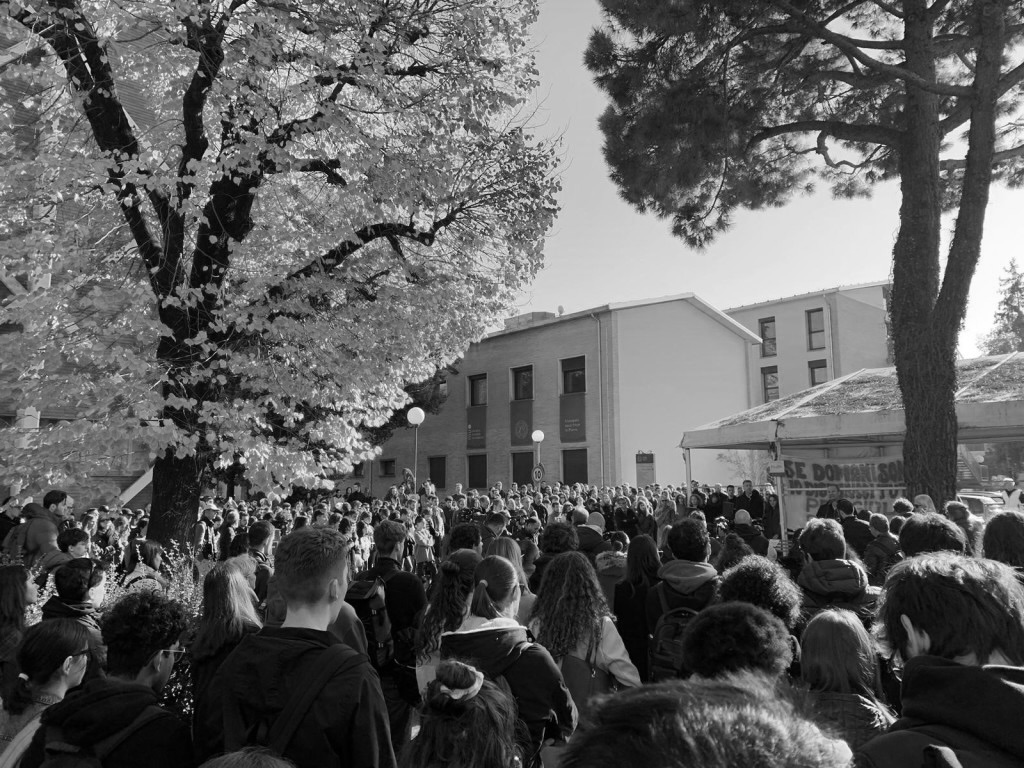
With Non Una Di Meno leading a demonstration in Rome, the feminist groups Be Free, Casa delle Donne Lucha Y Siesta, and Casa Internazionale delle Donne speak to The Matthew about gender violence. At the University of Padua, students honor the memory of classmate Giulia Cecchettin with ‘one minute of loudness.’
News
By Sofia Faid | Newsreporter
This article addresses the subject of gender violence, including femicide. Comments have been translated from Italian to English by reporter.
Women rights groups and student voices gathered and marched against gender violence in commemoration of the International Day for the Elimination of Violence against Women on Nov. 25. At the University of Padua, students honor the memory of classmate Giulia Cecchettin with “one minute of loudness,” a year after the ex-boyfriend committed the femicide.
On Saturday, Nov. 23, about 150,000 people joined the demonstration organized by the feminist and transfeminist movement in Rome Non Una Di Meno (NUDM, “Not One Less”). With banners reading “let’s disarming patriarchy” and “fighting against gender violence,” the march began at Piazzale Ostiense and arrived at Piazza Vittorio Emanuele.
Last year, the Italian National Institute of Statistics (Istat) reported that 96 women in Italy were victims of femicides This year, NUDM reported 104 femicides.
Before the march began, a photo of Minister of Education Giuseppe Valditara was burned in front of the Ministry of Education, in reaction to him saying that “patriarchy does not exist,” during a speech a week earlier in the inauguration of the Fondazione Giulia Cecchettin, in the Chamber of Deputies in Rome.
Gino Cecchettin and Elena Cecchettin, the father and sister of the victim, launched the Fondazione Giulia Cecchettin on Nov. 18, one year from the day that their relative’s body was found, said Gino Cecchettin in the inauguration. The Fondazione is fighting gender violence and raising awareness through educational campaigns and projects.
In the inauguration speech, Valditara said that sexual violence is also “linked to forms of marginality and deviance resulting from illegal immigration.”
“104 state deaths. It’s not immigration but education,” read a poster from an activist at the march.
According to a report from the national anti-violence center D.i.Re., in 74 percent of cases of violence against women, the abuser is Italian.
“[Gender] violence is mainstream,” says Ileana Aiese Cigliano, member of anti-violence organization Be Free in Rome. “Violence is widespread and does not have color, religion, or level of education, and this is one of those cases.”
Aiese Cigliano is also manager of the anti-violence center Le Farfalle of Cerveteri, and the assistant manager for the anti-violence center Federica Mangiapelo of Anguillara in Lazio, a center named to honor a 16-year-old student killed by her boyfriend in 2012.
According to Aiese Cigliano, because Giulia Cecchettin and her murderer were both white and Italian, because they came from respectable families, because they lived in a wealthy part of the country and they were both educated, their case did not “fit” the narrative that sees gender violence as, “confined in the slums, in ignorance, in being foreign, in all those that are stereotypes that somehow keep the conscious of the average men and women safe,” she said.
‘It could have been me, it could have been any of my friends.’
Nov. 11 marked a year since 23-year-old Filippo Turetta killed 22-year-old Giulia Cecchettin, from Vigonovo, Padua. She was a student of Biomedical Engineering at the University of Padua. Her classmates gathered on campus to honor her with “one minute of loudness” to fight the silence that for years has been covering gender violence.
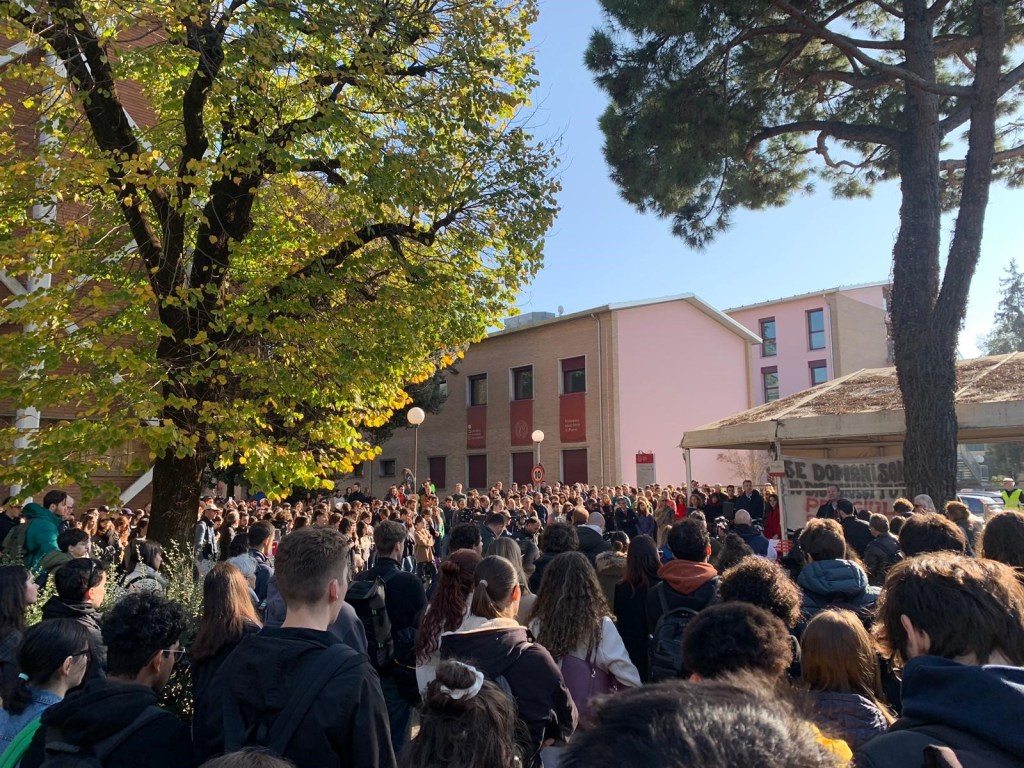
“We were studying for the same degree, we sat in the same rooms, had the same professors,” said Zoe Dall’Olio, a student from the same department as G. Cecchettin. “It could have been me, it could have been any of my friends.”
Turetta was convicted to life sentence on Dec. 3 by the Assisi Court in Venice for voluntary murder, aggravated by premeditation, and the concealment of a corpse.
“I remember when the first missing posters started circulating,” said Dall’Olio, “We all knew that they were going to find her dead, because it always ends like this. It’s infuriating.”
Viola Paolinelli, activist and operator for the anti-violence center Casa delle Donne Lucha Y Siesta, said that Minister Valditara had proposed to have “a minute of silence” to commemorate Cecchettin’s murder, but teachers and students responded differently.
“The schools in Italy decided that it was no longer necessary to remain silent,” said Paolinelli. “That perhaps it was necessary to find other means to express their anger and their impatience.”
According to Paolinelli, government actions have not led to any substantial decrease in the cases of femicide, and protests and demonstrations are necessary to trigger actual change.
“It’s quite demoralizing,” said Silvia Cesaroni, student at the Biomedical Engineering Department at the Universtiy of Padua. “Why do we even fight? I’ve seen a change in my peers, but not in the institutions. The road is still long.”
According to Cesaroni, most media outlets have been taking advantage of the case’s tragic nature to produce “mere sensational news stories.” She says that G. Cecchettin’s father and sister played a crucial role in bringing dignity and accuracy to the story.
Elena Cecchettin was the first one to blame this femicide on structural patriarchy, said Cesaroni.
On a famous letter that E. Cecchettin sent to Corriere della Sera after the femicide, she said:
“Turetta is often called a monster, but he’s not a monster. A monster is an exception, a person outside society, a person for whom society must not take responsibility for. But instead there is responsibility. The ‘monsters’ are not sick, they are healthy children of patriarchy, of rape culture.”
JCU students joined the NUDM demonstration last month.
“We need to really listen to women and hear their stories, even if it’s not easy,” says Anaisha Fernandez, junior student in Communications. “Even if sometimes one can feel hopeless, protesting is still really important,” she said.
Senior in Communications Marya Polovinkina, said everyone should do something in order for society to change.
“You don’t have to be a woman to take action,” said Polovinkina.
Suggested Readings
One woman killed every 10 minutes: The harrowing global reality of femicide | UN News
Giulia Cecchettin: Ex-boyfriend Turetta sentenced to life in jail
La verità sul numero dei femminicidi in Italia | Pagella Politica
Related stories
JCU Students Reluctant to Report Street Harassment Near Campuses
Learn More on Street Harassment
- What is Street Harassment – RAINN
- Check What You Can Do About Harassment – CitizensAdvice.org.uk
- Reporting Harassers Strategies – Stopstreetharassment.og
- Report and Support – Neighborhood Watch
- How to Report Stalking or Harassment – Police.uk
What is Victim Blaming
Street harassment represents one of the most pervasive forms of sexual violence.
Sexualized victims of stranger harassment and victim blaming: The moderating role of right-wing authoritarianism– L’Università degli Studi di Torino
Acceptance in Blame: How and why we Blame the Victims of Street Harassment
Victim blaming – the glass wall between harassment and justice
WHAT IS THE IMPACT OF VICTIM BLAMING & WHY DO PEOPLE DO IT?
Rape Culture, Victim Blaming and The Facts
La colpevolizzazione delle vittime perpetua la violenza contro le donne a Timor Est
 thematthewrome.com