
Chief Inspector of the State Police at Porta Pia, Evelina Compare, speaks to The Matthew on street harassment and police reporting protocols.
News Report
By Iris Russo | Newsreporter
This article addresses the subject of gender violence, including street harassment as a form of sexual assault. Interviews are translated from Italian to English by reporter.
This December marks six months since the launch of a free app in Europe that assists women in situations of street harassment: the VIOLA app. The organization behind it is V. SRL based in Rome, a street safety non-profit that fights against gender-based violence with a network of psychologists and lawyers.
V. SRL created the VIOLA app in reaction to the recorded 84 percent of women in the world who encounter street harassment before the age of 17. The app was also an urgent response to the 2021 murder of 33-year old Sarah Everard from London, kidnapped, sexually assaulted and killed by a police officer.
Since May, the VIOLA app has been downloaded 38,000 times and has gained more than 186,000 Instagram followers. The app was launched in Italy, Switzerland, Germany, France, Belgium, and Austria.
This app offers services like 24/7 video calls with more than 180 trained volunteers and emergency alerts through geolocation features that facilitate an emergency response from law enforcement. The location of the user is sent to the authorities through an emergency button, and the volunteers, who interact with the users through chat or video call, can send their positions to the authorities if they need it.
This street safety app was ideated by Forensic Legal Psychologist Ilaria Saliva, and Clinical Psychologist, Laura De Dilectis, and Psychotherapist Georgia Spencer Davison.
Davison said that VIOLA offers a complete safety system that combines technology with human support. The real-time tracking, volunteer-monitored calls, and the features planned for mid-2025 with a unique mix of tools and care ensures users feel supported and protected every step of the way.
This article is not sponsored by V.SRL. The team responded to initial questions via email and were busy to meet in person. Other street safety apps are Walk Safe and Street Safe.
University Students Experience Increasing Street Harassment and use the VIOLA app
A 2023 survey of 800 women aged 18 and older conducted by Lorenzo Macchi, a Statista research expert on Italian society, economy, and politics, demonstrates that:
- 60% of Italian women have been subjected to sexually suggestive comments at some point in their lives
- 35% have felt unsafe in situations where they feared a potential sexual assault
- 26% reported being touched in private areas without their consent
- 24% have been kissed against their will
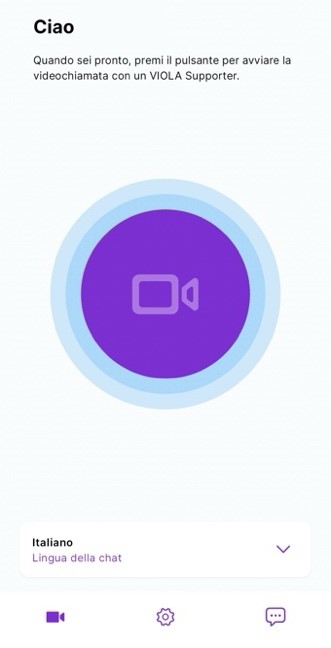
University of Palermo students, Sara Cottone, Morena Nicolosi, and a student from Forlì University, Anna De Carne, have used the VIOLA app.
De Carne, a student living away from home, said that she initially felt very afraid to walk home alone, which significantly restricted her freedom.
“Since discovering the app, I am much calmer,” she said. “While I acknowledge that something could still happen, I take comfort in knowing there’s always someone ready to step in immediately if needed at any time of the day.”
Nicolosi said that the video call and geolocation features of the VIOLA app have “transformed” her sense of safety when she’s out alone.
“Just knowing that I can start a video call with any volunteers and that my location can be tracked gives me a strong sense of protection,” she said. “It reassures me that someone is ready to step in if anything happens, and that’s why it has significantly changed how secure I feel.”
Similarly, Cottone said that volunteer support on the VIOLA app is effective and immediate, and this has strongly improved her confidence and sense of control in public spaces.
“I feel much safer going out alone now because I know the VIOLA app will always be with me,” she said. “The volunteers are always available and ready to help if I ever have an urgent need. It has definitely given me more confidence to go out alone at any time of the day.”
Dina Haljeta is a VIOLA app Shift Assistant, a type of volunteer who helps coordinate the availability of the other volunteers, considered as “supporters,” to ensure there is always someone ready to provide assistance through the app.
Haljeta said that coordinating supporters’ availability across countries and time zones can be difficult, but it is vital to provide consistent and uninterrupted support.
“Our goal is to ensure that every language channel is always covered by more than just the minimum,” said Haljeta. “So that we can provide the best possible support for our users, especially during those critical times.”
Depenalization of Article 726
Reporting to the police or law enforcement, however, is not a guarantee of safety or support. Since 2015, the Italian penal code Article 726 decriminalized street harassment. Before the law changed, this type of behavior was considered a criminal offense. The sexual offender could face legal consequences, even jail time.
After the decriminalization of the offense of indecent act in a public place (Article 726 of the Penal Code) through Legislative Decree No. 8/2015, obscene acts are now treated as an administrative offense, not a criminal act. Instead of going through the court system and facing a criminal punishment, the person who commits an obscene act or public indecency may only face an administrative fine, which can be from 5,000 euros to 30,000 euros, depending on the local authorities’ decision.
For survivors, this change makes it harder to take legal action against the person, because the situation is no longer considered a crime unless it happens close to minors.
Many survivors have had to endure indecent exposures and groping in the street.
Asia’s Testimony Near a Childcare Center in Trastevere
A 22-year-old Italian student from Rome, who will be named Asia in this report, decided to give her anonymous testimony of street harassment under journalism codes of ethics and the Editors Codes of Practice.
In June 2023, Asia was walking on the street of Via Quirino Majorana in Rome when she felt a gaze upon her. When she turned, she saw a man in a car engaging in indecent exposure and autoeroticism while staring at her.
Asia froze at first but then decided to take a picture of the license plate of the man’s car. She said she wanted to sue him, and when she went to report the crime in the Trastevere Police Station, but the officer told her that she could not do this.
“Looking doesn’t mean offending,” was the response that Asia heard. “This is just public indecency; you can report this crime only if he was close to minors.”
Asia followed up to this information. She identified that the location where she experienced street harassment happened 210 meters away from a childcare center. She went back to the police station to inform the officers that the abuser had been exposing his genitals and performing obscene acts near a childcare center.
The officer said he could have let her report this only if the sexual offender was doing this in front of minors. When Asia told him that the harasser was too close to a childcare center, he refused to print the photo Asia took of the license plate of the car.
“If you want to report this, then go to the print shop and bring me the image printed out,” the officer told Asia.
Asia says that the officer only cared about judging her experience.
“He did not care about me, the victim of the crime,” says Asia.
According to Asia, the depenalization of these aggressions allows the Italian law to see this type of sexual harassment as a less serious issue, which makes it harder for vicitms to feel protected and for authorities to take meaningful action against it.
Asia said that she could not acknowledge the pain, shock, and trauma that she felt when knowing she could only report this crime because the sexual offender was close to the childcare center, and not because the man was enacting autoeroticism while he was looking at her and moving towards her.
“I still remember that man looking at me and moving towards me from inside the car, as if he wanted me to get close to him,” she said. “I was afraid that he could have opened the car door and assaulted me. I felt powerless, I did not have the power to choose what that man did to me, and I did not have the power to report this crime for myself. I did not count, and this made me regret to report this, especially because of the officer.”
Asia is one of the many survivors who regret to report this crime because of the police officer’s behavior.
“After sending me to print that picture, he asked me several questions about what I did, if I stopped, if he had lowered his pants, or if his penis was sticking out of the zipper,” said Asia. “I have always known that police officers’ behavior is problematic when a woman goes to them to report these types of crimes, but I thought that maybe this time he could have been more empathic.”
Under an Instagram post of the Italian Police, more than 4,000 women survivors of gender violence and sexual harassment, comment that they have not received the support that they expected when reporting to the police. Many also comment on officers of law enforcement catcalling them, among other forms of harassment.
A survey conducted by Quorum/YouTrend for Sky TG24, carried out between Aug. 29 and Aug. 31, 2023 revealed that out of 800 respondents:
- 74% of Italians think it is not easy to report sexual violence in Italy.
- 26% of Italians believe that the behaviour and clothing of victims are factors that contribute to sexual violence.
According to Istat, in Italy:
- 31.5 percent of women aged 16 to 70 have experienced some form of physical or sexual violence during their lifetime (6.788 million)
- 20.2 percent of women have experienced physical violence (4.353 million)
- 21 percent of women have experienced sexual violence (4.520 million)
- 5.4 percent of women (1.157 million) have been subjected to more severe forms of sexual violence, such as rape (652,000) and attempted rape (746,000).
Police Reporting Protocols- an Interview with Porta Pia Inspector Evelina Compare
The 47-year-old Chief Inspector of the State Police at the Rome Police Headquarters of Porta Pia, Evelina Compare, is known in Rome for the emphatic protocols she has with survivors of sexual assault. She is an expert on gender-based and domestic violence.
Compare said that she chooses not to wear her uniform when a survivor reports a crime of sexual abuse.
“Wearing my uniform is a source of pride and a privilege for me,” said Compare. “When not wearing, it simply means allowing the victims who enter to find themselves not only before an institution, but also as the mother, the woman, the friend who is under that uniform.”
“Complainants believe they must make a report of any kind, they often do not know whether they can make a criminal complaint or whether it is an administrative offense,” said Compare. “Generally, if they want to make a report, in any case, they can defer to the decisions of a judicial authority.”
When she encounters this type of scenario, Compare refers the report to the will of a judge, who may perhaps deem it appropriate to see a criminal offense, even outside of canonical norms, where a specific succession of events is described.
The inspector expressed her opinion on Asia’s case and the officer’s protocol:
“I do not agree with the protocol that was practiced by the officer,” she said. “I can assure you that if the person had come here, not to me, Evelina Compare, but to this police station, she would certainly have been received in a different manner.”
She said that, in any case, women must be welcomed by practicing the protocol relative to domestic violence and sexual abuse.
“We are trained in this way because you can never know how disturbed a woman might be or what has happened when she comes in to tell you something,” said Compare. “Therefore, the protocol must always be applied.”
Punti Viola in Rome
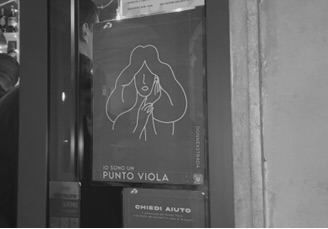
Punti Viola (Viola points) are any public establishment in the city which have been sensitized and trained to address gender-based violence and promote safety in public areas. Punti Viola serve as a local point of reference equipped with awareness and tools to assist individuals facing difficult situations.
The staff in each point follows a training conducted and written by lawyers and psychologists for these places to become support centers for women in danger.
According to the network DonneXStrada, its overarching goal is to empower citizens to actively combat violence by starting at the community level and building a supportive network for victims.
DonneXStrada says that this project involves careful selection, awareness-raising, and specialized training provided by DonneXStrada’s legal and psychological team. By collaborating with DonneXStrada, participants contribute tangibly to combating gender-based violence, improving public safety for women, and ensuring community well-being.

In Rome, the Punti Viola near John Cabot University include the Arci Zalib Club, the Vino and Vinili Winebar, and the Bar Tartaruga.
Arianna Beciani and Tommaso De Angelis, volunteers at the Arci Zalib Club, say they have always noticed that Trastevere can be a problematic area where people find themselves in dangerous situations, especially on Friday nights while trying to move from point A to point B.
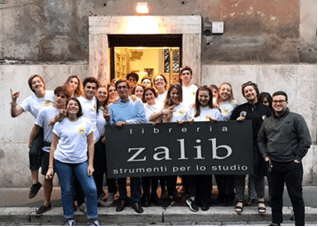
According to De Angelis, even though they don’t have a central position in Trastevere, their street ends at the dormitory of John Cabot University, so there is usually a large group of foreign students passing through.
“Before becoming a Punto Viola, once happened that a girl sought refuge with us just a few meters from her dormitory, because some men were harassing and following her,” De Angelis said.
“After she entered our space to stay safe, they remained outside for over two hours, waiting for her to come out. In fact, we left around 5:30 a.m. and accompanied her back to the dormitory, which was no more than twenty meters away—a distance that, for her, could have been crucial.”
Beciani said how they have always been a safe place for women, even before becoming a Punto Viola.
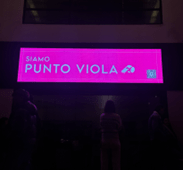
Marco Milillo, a volunteer from the Punto Viola in Vino and Vinili, said that the Punto Viola is an intelligent and kind initiative.
“What we aim to be is a listening point, much like what the association itself does,” said Milillo. “A gentle intermediary to help girls understand that they are not alone and that, through a simple initiative, significant issues can be addressed.”
“These might not necessarily be extremely bad or violent but could also simply be moral concerns. So, this is where we stand, and we want to continue with this,” he said.
Francesco Di Domenico, a volunteer of the Punto Viola Bar Tartaruga, said that becoming a Punto Viola was helpful in raising awareness about psychological and physical violence against women. This had a strong impact on one of his colleagues, a victim of stalking by her own boyfriend.
According to Di Domenico, the training to become a Punto Viola made by psychologists and lawyers made them understand how psychological violence is damaging just as much as physical violence.
“Educating herself and speaking out helped my colleague a lot,” said Di Domenico. “However, her boyfriend had reached a point where he subjected her to severe psychological violence such as taking her phone, following her, and threatening her. He did everything except physical violence, but he did everything else. He even forced her to quit her job at the bar. Then, after many months, after they broke up, she returned to work.”
Di Domenico, De Angelis, Beciani, and Milillo said that the training has equipped them with the skills to handle sensitive situations, reinforcing the belief that while they are not professionals, they can still offer critical first steps of support.
Students Visit Establishments with Punti Viola
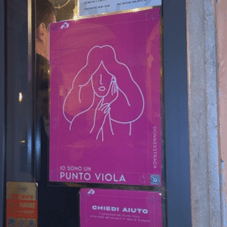
Three university students from La Sapienza, Giorgia Fazio, Adele Saladino, and Giulia Capraro, say these spaces have offered them offering security, empathy, and practical support to women in distress.
Fazio has said that she decided to seek help at a Punto Viola, after the repeated experiences of feeling unsafe in the streets of Rome, particularly after incidents of harassment that she has experienced.
“During the day, I often feel unsafe, especially at night, because I might receive unwanted comments or even be followed,” Fazio said. “So when I was followed and harassed again, I decided to go to the Viola Point.”
Fazio says that a woman cannot feel at ease in this society, because there is no adequate sexual or gender education that allows women to always feel safe when they leave their house, especially at night. Having reference points like these “is essential, they can give you a bit of hope for society and allow you to see how change is happening,” she said.
Saladino has also used a Viola Point when going on a date with a man she met on Tinder.
“I didn’t feel very comfortable with him before the date, so I thought that the best choice for me was going to a Viola Point and having a date there,” said Saladino.
She noticed the bartender at the place of her blind date being aware of her face knew when something made her uncomfortable simply by how her face looked at that moment. She said that the bartender told her later that he could tell it was their first date just by watching how they talked and interacted when they walked into the pub.
Saladino thinks that she could have seen that the bartender took part in the “efficient training, by how he moved towards us during the aperitif when he noticed that there was something wrong,” she said.
He went to ask her if everything was okay, bringing a bottle of wine, and pretending to serve her while the man that she was having a date with was in the toilette.
Student Caparo said she also used the Viola Point to seek help after being followed by a group of men in the street.
“When I found the closest Viola Point and went there, I felt very scared,” said Caparo. “But knowing you are turning to people who are trained for these kinds of situations was very reassuring. As soon as I walked in, a young woman immediately came over to me, started calming me down, gave me some water, and helped me relax and feel at ease. She even walked me home afterwards.”
Capraro said that that having a supportive community during moments of danger and vulnerability provided her hope and a sense of empowerment, especially when returning home at night.
Related Stories
- JCU Students Reluctant to Report Street Harassment Near Campuses
- Women’s Rights Organizations And Students Speak Up Against Gender Violence on the International Day for the Elimination of Violence Against Women
- Any victim is a liar’: sexual violence scandals in Italy expose deep-seated sexism
Learn More on Street Harassment
- Check What You Can Do About Harassment – CitizensAdvice.org.uk
- Reporting Harassers Strategies – Stopstreetharassment.og
- Report and Support – Neighborhood Watch
- How to Report Stalking or Harassment – Police.uk
What is Victim Blaming
Street harassment represents one of the most pervasive forms of sexual violence.
Sexualized victims of stranger harassment and victim blaming: The moderating role of right-wing authoritarianism– L’Università degli Studi di Torino
Acceptance in Blame: How and why we Blame the Victims of Street Harassment
Victim blaming – the glass wall between harassment and justice
WHAT IS THE IMPACT OF VICTIM BLAMING & WHY DO PEOPLE DO IT?
Rape Culture, Victim Blaming and The Facts
La colpevolizzazione delle vittime perpetua la violenza contro le donne a Timor Est
 thematthewrome.com