
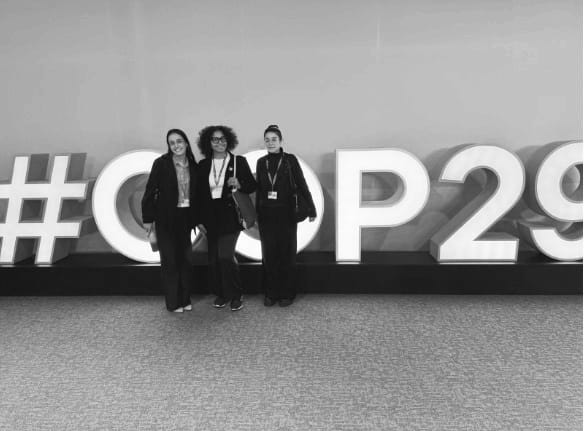
Report
By Martina Atanasova |Edited by Annalucia Scotto di Clemente
Baku felt like a bridge between two contrasting worlds from the first day: the cold, structured post-Soviet influence and the vibrant, intricate culture of the Middle East. This unique blend of cultures mirrored my own heritage, making my experience at COP29 in Azerbaijan deeply personal.
As part of our JCU delegation, we stayed in Khatai, a district far removed from the glitz and glamour of Baku’s city center, where COP29 took place. It was here, amidst the everyday hustle and warmth of the locals, that we experienced the real Azerbaijan.
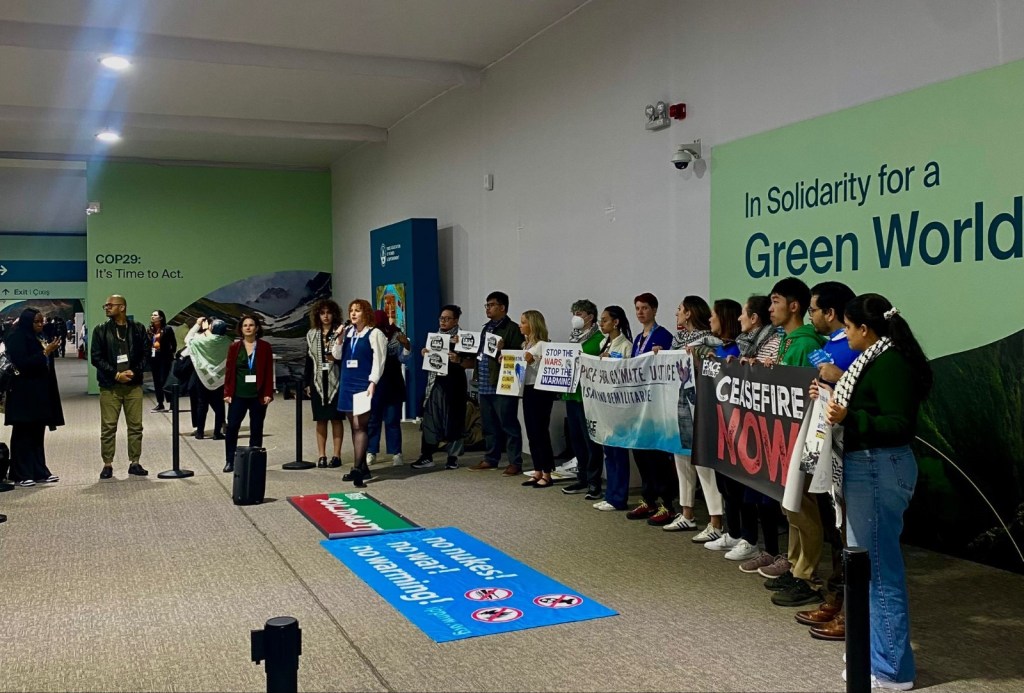
Image Credit: Martina Atanasova
The people were welcoming in ways that reminded me of my childhood in Lebanon and Bulgaria—hospitable sharing stories and making us feel at home despite the bustling atmosphere. The air was thick with the smell of gasoline, a visceral reminder of Azerbaijan’s oil-rich economy that hosted the biggest UN climate conference. At first, it was overwhelming, almost disorienting, but as the days passed, I found myself adjusting to it. Still, it felt like a metaphor —a potent mix of wealth and environmental cost, altering perceptions and priorities.
COP29 itself was a whirlwind. The event was overwhelmingly youth-driven, and the hundreds of Azeri volunteers left a lasting impression on me. Their discipline and dedication were awe-inspiring. They managed the logistical chaos with grace, ensuring that every session ran smoothly. Their pride in representing their country shone brightly, even as they quietly contended with the controversies surrounding the COP29 presidency.
Despite the diplomatic tensions, they maintained an aura of professionalism that kept the conference on track.
Yet, the disparities within COP were hard to ignore. In the sprawling pavilions, lobbyists for powerful industries darted between private and state-backed exhibits, selling corporate solutions that often seemed detached from the realities on the ground. Meanwhile, youth activists protested tirelessly outside, raising their voices against systems that prioritize profit over the planet. Inside, negotiators were cloistered in rooms, hammering out agreements on adaptation, mitigation, and loss and damage. The weight of these discussions was palpable—this was the future of our planet being debated, clauses by clauses, articles by articles.
Policy Reflections: Law, Finance, Military Emissions Gap and Climate Justice
As part of my role as observer, I attended critical negotiation meetings that profoundly shaped my understanding of the challenges facing global climate action.
One session that left a deep impression on me was Advancing Climate Justice Through the International Rule of Law. Justice Jawad Hassan of Pakistan emphasized the urgent need to transition from “soft law” principles to enforceable “hard law.” His vision of climate finance as a legal obligation—not just a goodwill gesture—resonated deeply. Whether through the Carbon Unit Act or mechanisms like the Green Climate Fund, he argued that financial commitments must be bound by robust legal frameworks, where accountability and technical support between nations are international imperatives.
Similarly, Christina Voigt from the University of Oslo provided a compelling argument for how the Paris Agreement’s temperature goals could serve as an interpretive tool for courts to hold states accountable. Her insights into customary international law prohibiting transboundary harm, and the growing role of apex courts in shaping climate obligations, painted a hopeful picture of how law can evolve to meet this crisis.
These sessions revealed a profound truth: the fight for climate justice is not just about securing resources—it’s about fundamentally restructuring systems of accountability. States must fulfill their obligations not only to reduce emissions but also to ensure that legal frameworks protect the most vulnerable.
In discussions on Loss and Damage—perhaps the most contentious topic of COP29—I learned just how enormous the gaps in policy and financing remain. Vulnerable countries, especially those affected by displacement and agrifood system disruptions, bear the brunt of climate shocks, yet receive only a fraction of global climate finance. During one meeting, Senator Shantal Munro from Barbados recounted how her country had to rebuild housing and agricultural systems after devastating hurricanes, often with delayed and insufficient international support. Her advocacy for structural changes in global financial systems, including the establishment of the Loss and Damage Fund, was both inspiring and sobering.
Throughout the discussions at COP29, one question kept echoing in my mind: Can we truly prioritize climate change when the world is engulfed in war, armed conflict, and humanitarian crises?
One of the most striking revelations at COP29 came during the session on Measuring Climate Impacts Across the Cycle of Armed Conflicts. Ukraine’s Deputy Minister of Environmental Protection, Victoria Kyreiva, painted a harrowing picture of the environmental devastation caused by the war in Ukraine. Beyond the catastrophic human tragedy, the financial and ecological costs are staggering. Total damages have reached €65 billion, including €19 billion from air pollution, €2 billion from water pollution, and €28 billion due to soil destruction. Ukraine is now the most land-mined country in the world, with 30 percent of its territory rendered unsafe, leaving a toxic legacy that will endure for decades.
The environmental devastation has been equally grim. The war has led to the loss of three million hectares of forest, obliterating critical biodiversity and destroying a vital carbon sink. One million people now lack access to drinkable water, a humanitarian and ecological crisis that exacerbates already fragile conditions. Over the past two years, 280 million cubic meters of air pollution have been released, worsening the global climate emergency. On a broader scale, the war has added substantial greenhouse gas emissions to the atmosphere, a silent yet potent driver of climate change.
Despite this devastation, Ukraine’s resilience and commitment to climate accountability stood out. Even amidst an ongoing war, Ukraine has adhered to its international climate obligations by submitting detailed reports on wartime greenhouse gas emissions. The government is also developing frameworks for green reconstruction, focusing on low-GHG rebuilding strategies and ecosystem restoration as part of its broader recovery efforts. This commitment is rooted in a vision of carbon neutrality by 2050, an ambitious target tied closely to Ukraine’s aspirations for European Union membership. In essence, Ukraine is attempting to rebuild not only its infrastructure but also its natural systems while maintaining a commitment to the global climate agenda.
The session also illuminated a broader, largely overlooked issue: the significant role of armed conflicts as contributors to climate change. Experts like Lennard de Klerk and Benjamin Neimark presented eye-opening figures, revealing that globally, conflicts contribute an estimated 200 million tons of CO₂ annually. These emissions stem from increased fossil fuel use, artillery activity, and the destruction of forests and energy infrastructure. Even indirect emissions, such as longer aviation routes caused by Siberian airspace closures, compound the problem. While precedents like the Iraq-Kuwait war offer examples of environmental compensation, there is still no standardized methodology to accurately measure or address these emissions.
In follow-up meetings, representatives from the European Union Delegation acknowledged the importance of integrating conflict-driven emissions into global accountability frameworks but highlighted the significant political challenges in securing consensus. A conversation with a UNEP delegate revealed similar frustrations, as conflicts continue to be framed primarily as humanitarian crises, sidelining their devastating environmental impacts in international negotiations. There was a shared understanding that any attempt to quantify these emissions or hold accountable parties responsible would require innovative approaches under frameworks like Article 6.4 of the Paris Agreement, which could provide a structure for reporting and addressing emissions linked to conflicts.
One of the most glaring oversights in the climate negotiations was the lack of attention to military emissions. If global militaries were a country, they would rank as the fourth-largest emitter of greenhouse gases. Yet these emissions are systematically underreported or excluded entirely from national inventories. Only four Annex I countries currently report military emissions under voluntary guidelines, while key military powers like India, Saudi Arabia, and Israel provide no data despite their sizable defense industries. This gap is compounded by the challenges posed by occupied territories, such as Crimea, where competing claims of jurisdiction lead to risks of double-counting emissions, making accurate reporting nearly impossible.
Military emissions were noticeably absent from COP29’s agenda. This omission reflects the political sensitivities and logistical hurdles that prevent their inclusion in global accountability systems. During discussions with negotiation teams, the need for consistent methodologies to address these blind spots emerged as a recurring theme. Suggestions included leveraging Article 6 mechanisms to incentivize countries to include military emissions in their inventories. However, negotiators expressed concern over resistance from powerful states unwilling to open their defense sectors to international scrutiny.
The session also explored how international law might address the environmental toll of conflicts. A notable development has been the United Nations General Assembly’s request for an advisory opinion from the International Court of Justice on the link between greenhouse gas emissions and war crimes. This unprecedented step could integrate environmental damage into legal frameworks for accountability, paving the way for reparations and funding for sustainable restoration in post-conflict scenarios. Ukraine, for example, has been developing compensation mechanisms to rebuild not only its economy but also its ecosystems, envisioning a form of green reconstruction that could set a global precedent.
This dialogue underscored the urgent need for consistent, transparent, and accurate methodologies to measure the environmental impacts of conflicts. The lack of reliable data due to restricted access to conflict zones and intentional misinformation only amplifies the problem. War leaves a toxic legacy not only for the communities directly affected but also for the planet. Addressing these impacts requires the world to reimagine its approach to conflicts, with international institutions like NATO and global militaries aligning themselves with the Paris Agreement and acknowledging their role as climate actors. Only then can we hope to tackle the invisible yet devastating scars that war leaves on our environment.
Personal Lessons Amid Global Challenges
Between navigating the intense policy discussions and experiencing the vibrant streets of Khatai, I found moments of reflection. The real Baku, with its blend of resilience and hospitality, reminded me of why these negotiations matter. The people living at the margins—whether in the Middle East or Ukraine—are the ones who feel the immediate effects of decisions made in those negotiation rooms.
The outcomes of COP29 in terms of climate finance have been met with mixed reactions. A key financial agreement reached at the summit was the commitment of $300 billion to address climate change, a sum to be raised by 2035. However, this amount is significantly less than the $1 trillion per year that developing countries had been calling for, with many economists arguing that this is the minimum required for developing nations to effectively tackle the climate crisis.
Many representatives from vulnerable nations expressed disappointment, emphasizing that the $300 billion figure falls short of the urgent needs driven by climate change impacts in low-income countries. Some delegates criticized the lack of goodwill from developed nations and argued that the pledged amount was inadequate for avoiding catastrophic climate consequences. Furthermore, the debate around climate finance at COP29 was complicated by the participation of large fossil fuel economies, such as China and the Gulf states. While these countries were not required to contribute to the fund, a mechanism was introduced for voluntary recognition of their contributions.
Despite these challenges, the conference did manage to establish a roadmap for scaling up climate finance, including mechanisms like grants and concessional loans, which are more favorable for developing countries, but how applicable that would be is questionable. This agreement is seen as a “downpayment” toward more ambitious funding goals in the future, but the disparity between the funding required and what was agreed upon reflects the ongoing struggle for equitable climate action.
Nevertheless, behind climate change stand personal stories seeking equitable justice. COP29 reinforced a lesson I’ve carried with me throughout my life: resilience is not a passive state but an active everyday resilience building towards positive peace and environmental stability, which should be enforced through a strict COP framework. Whether it’s the youth activists protesting outside the conference, the young Azeri volunteers working tirelessly to ensure its success, or the negotiators pushing for legal and financial reforms, every individual plays a role in the broader struggle for climate justice.
As I left Baku, I carried with me a deep sense of urgency for adequate policy. The conference highlighted both the remarkable progress and the glaring gaps in our global response to the climate crisis.
Above all, it underscored the need for action that is not only equitable but also rooted in justice—ensuring that every community, every voice, and every life is protected.

JCU Delegation, Observer for COP29 – Image Credit: Martina Atanasova
 thematthewrome.com