Poets, translators and students contribute to the upcoming volume of InVerse’s bilingual anthologies.
News
By Alex Payá Barrachina | Newsreporter
InVerse-Italian Poets in Translation, will celebrate its 20th anniversary in late spring of next year with the release of its ninth volume and its traditional festival and reading ceremony.
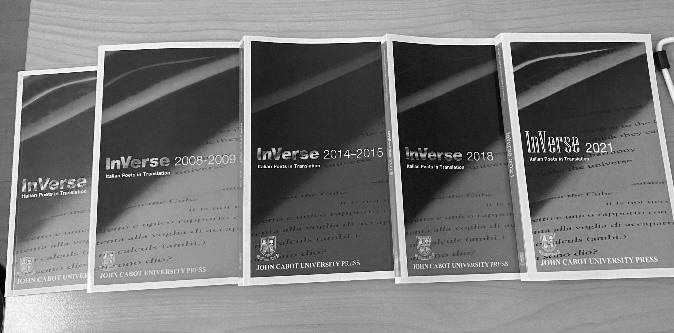
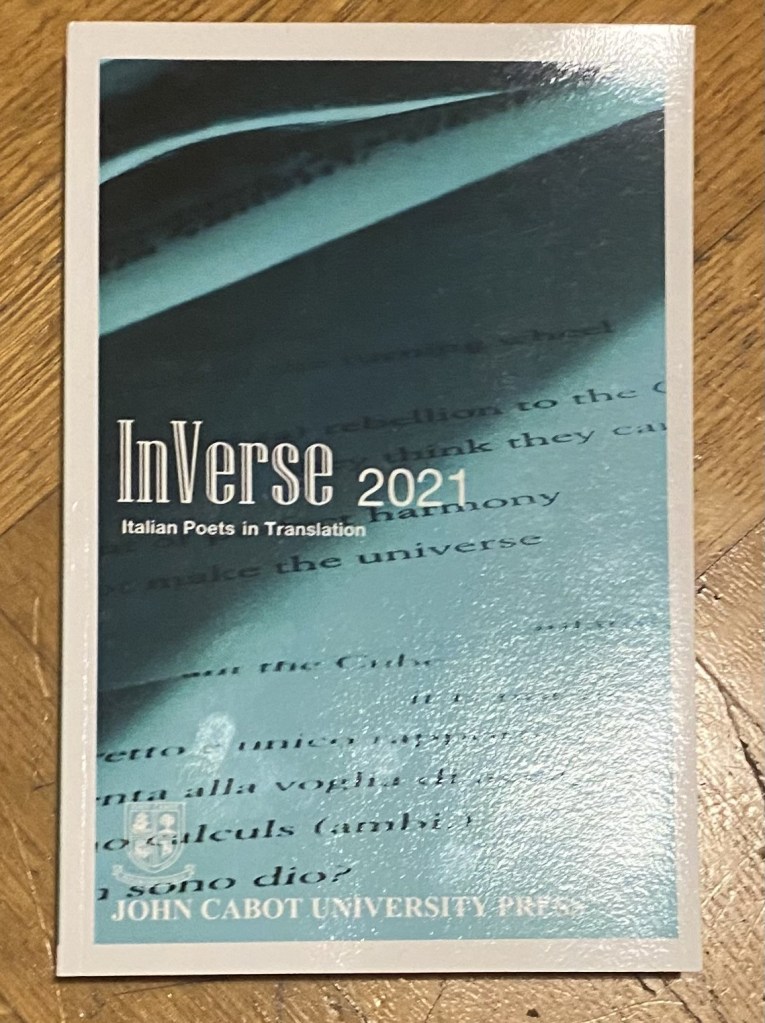
Founded in 2005 by JCU professors Brunella Antomarini, Rosa Filardi, and Berenice Cocciolillo, each InVerse bilingual anthology features the works of 15 to 25 Italian poets with their poetry translated into English. The last anthology was published in 2021.
“We find it very gratifying for the poets to prepare the anthology,” said Professor Cocciolillo, Director of Web Communications and Adjunct Assistant Professor of Italian. “We try to find a balance between well-known poets and new young poets that don’t have the opportunity to be translated.”
The ninth edition in 2025 will mark the first inclusion of student’s translation work from Professor Cocciolillo’s Introduction to Professional Translation class, IT 308. Although students have participated as readers in previous InVerse festivals, this is the first time that their translations will be featured in this professional publication.
“The intent of InVerse from the beginning was to make Italian poetry to be known outside of the country,” said Professor Filardi, Italian language and Theater lecturer at JCU.
Professor Antomarini, Adjunct Assistant Professor of Philosophy at JCU, said that the festival’s name, InVerse, simply refers to placing something in reverse– translating Italian texts into English.
InVerse combines two elements that are part of the festival’s cultural essence: the bilingual anthology and the poetry reading ceremony in both languages. The InVerse anthologies are published by John Cabot’s University Press and distributed by Rowman & Littlefield. The eight volumes can be found in JCU’s Frohring Library.
The selected poets in each anthology range in diversity of experience and age.
According to James Schwarten, former JCU Italian studies and sociology professor, the InVerse’s bilingual anthology may help English-speaking students at John Cabot to read more poetry.
Schwarten will be featured in next year’s anthology. He has contributed with translations of the 2018 and 2021 editions. Born and raised in Milwaukee, Wisconsin, he has lived in Italy for 35 years. With a deep command of the Italian lexicon, Schwarten produces work in both languages.
“It’s a pleasure and a thrill to be part of a small community of translators,” said Schwarten.
According to Schwarten, promoting poetry festivals is important because “they aim to educate and attract new readers,” making InVerse one of these many poetry festivals that exist around the world.
JCU alumnus Cristopher Schwarten will also appear in the next anthology. He took Professor Cocciolillo’s translation class in 2022 and wrote his thesis on translation.
“I hope the anthology will draw readers to Italian literature as well as to translation,” said C. Schwarten.
According to C. Schwarten, the evolution of the festival over the years has been essential in engaging the university community.
“It has built a bridge between different cultures and cultural backgrounds,” he said.
For the anthology, C. Schwarten has dedicated time to studying and translating poems by the Italian writer Mariasole Ariot.
“Ariot’s unique style and themes were both challenging and rewarding to translate,” he said. “I particularly enjoyed finding ways to convey her voice in English and collaborating with her throughout the process.”
Both J. Schwarten and C. Schwarten, father and son, recommend meeting with the poet or speaking on the phone before the beginning of the translation process.
“[The poets] are the ones who know the answer to all of our questions,” said J. Schwarten. A translation transcends “the words on the page,” as it involves “the affective or emotional quality of the poem.”
C. Schwarten said that this dialogue helps ensure a final translation that both author and translator “are happy with.”
Nefeli Misuraca, JCU Adjunct English professor and poet, published five of her poems in the last anthology with her own English translations.
According to Professor Misuraca, the InVerse Festival helps unknown poets’ works to be expanded and brings together people who are curious about poetry.
Professor Misuraca said poets should never give up and must keep up with the courage in a world that seems to be losing freedom. She said poetry has played a significant role in her own freedom of expression.
In her poetry, Professor Misuraca prioritizes “the sounds and melody of the words” over their “actual meaning.” Word’s actual meanings and phonetic structures, which increase the poem’s melodicism, can equally contribute to the success of a poem, she says.
Professor David Castronuovo currently teaches English at JCU. Previously, he taught History of Opera at JCU and Italian Poetry at Middlebury College. When reading poetry, he says he enjoys “letting the sound of the poem work.”
According to Professor Castronuovo, poetry plays a significant role in today’s world, as it helps people slow down in an era where everything moves quickly. He’s constantly surprised by the number of people in Rome who read and write poetry, “so whatever role it plays, it keeps playing,” he said.
From his experience working in Lyric Opera, he explains that there are two approaches when looking at an opera and poetry piece: “one is to prepare, study, read word by word, look up every word, define,” he says. “The other is to just let it wash over you and see what it says to you without preparation.”
When encountering a poem with a meaning that is not immediately accessible, Professor Castronuovo first approaches it almost as “nonsense.” After reading and listening to the poem several times, he then reviews someone else’s analysis to gain deeper insight.
Without counting next year’s anthology, 123 poets have been featured in InVerse’s bilingual publications, including: Edoardo Albinati, Giovanni Raboni, Milo De Angelis, Patrizia Valduga, Nanni Balestrini, Tomaso Binga, Silvia Bre, Mariangela Gualtieri, Jolanda Insana, Valerio Magrelli, Vito Riviello, Andrea Zanzotto, Maria Luisa Spaziani, Antonella Anedda, Franco Loi, and Chandra Livia Candiani.
“It’s grown and evolved with more people,” said Professor Cocciolillo. “We’re very happy about it.”
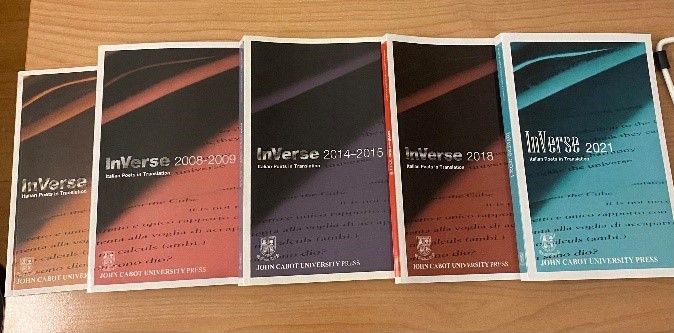
Photo by Alex Payá.
InVerse does not publish its volumes annually, as the three professors try to balance their professional responsibilities with the demanding task of editing and publishing a bilingual anthology.
“In the beginning, we were trying to do it every year,” said Professor Cocciolillo. “Then we asked ourselves, ‘Can we do it every year?’ and eventually decided to approach it a bit more irregularly.”
The exact date and location of the festival’s ceremony in 2025 are yet to be determined. The founders said they are hoping to celebrate this accomplishment in the evening and outdoors if the weather permits it.
 thematthewrome.com