
Report
By Francesca Motta | Edited by Annalucia Scotto di Clemente

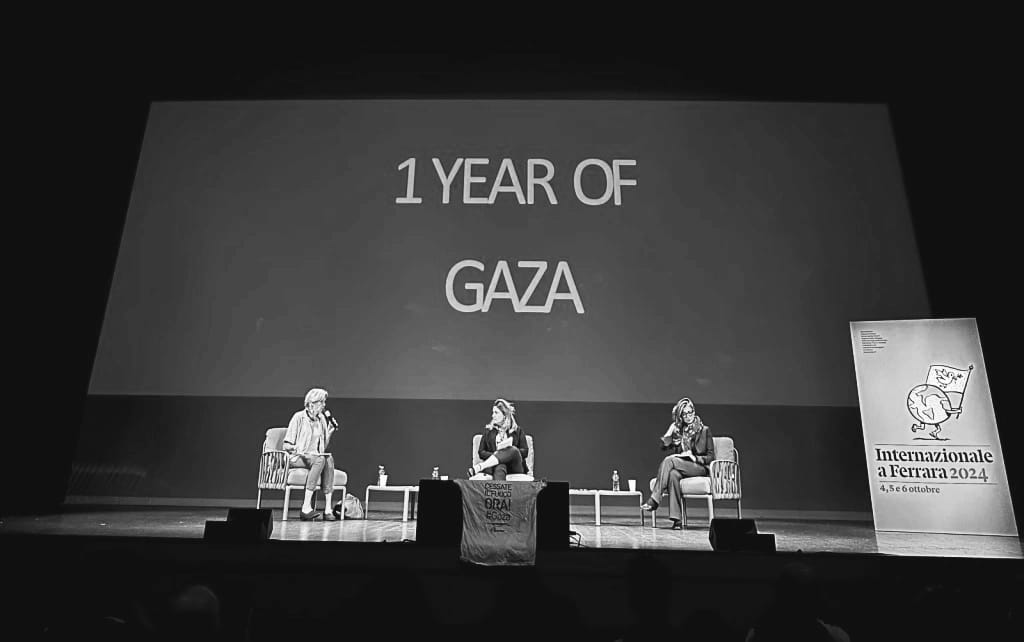
On Oct. 6, Francesca Albanese, the United Nations Special Rapporteur on the situation of human rights in the Palestinian Territory occupied since 1967, and Meinie Nicolai, General Director of Doctors Without Borders (MSF) in Belgium, delivered a speech at the Internazionale Festival of Journalism in Ferrara.
Coinciding with the grim anniversary of last year’s escalation of violence in Gaza, their discussion laid bare the ongoing humanitarian crisis and the systemic nature of Israel’s occupation of Palestine, described by Albanese as a “continuum of colonization spanning over 75 years.”
Genocide or Self-Defense?
Albanese’s remarks focused on the concept of genocide under international law, particularly under the United Nations framework.
“Genocide,” she explained, “can be constituted even by a single act, such as killings or infliction of severe physical or mental harm, when accompanied by the intent to destroy and erase, in whole or in part, a national, ethnic, racial, or religious group.”
Albanese argued that Israel’s policies in the occupied Palestinian territories reflect such intent.
“It is evident in the actions targeting Palestinians across all of historic Palestine. This is not a matter of isolated incidents but part of a broader project of ethnic cleansing, as outlined in Israel’s 2018 Nation-State Law,” she said.
She described the Nation-State Law as a legal framework for apartheid, asserting Jewish supremacy at the expense of Palestinian identity.
Passed in 2018, the law establishes Jewish settlement as a national value, de-prioritizes Arabic as an official language, and excludes Palestinians from the right to self-determination.
Destruction of Healthcare and Civilian Lives
Meinie Nicolai, General Director of Doctors Without Borders (MSF), highlighted the severe humanitarian impact of the ongoing conflict in Gaza, focusing on the destruction of healthcare infrastructure.
“Out of 36 hospitals in Gaza, many have been destroyed or rendered inoperative,” she said.
Nicolai described the targeting of hospitals and ambulances as intentional, emphasizing its impact on civilians. “This is not just collateral damage. It is systematic, and it violates the very core of International Humanitarian Law.”
Since the escalation began on Oct. 7, 2023, over 44,000 Palestinians according to the Palestinian Ministry of Health, including 17,000 children.
The destruction of essential medical facilities and the ongoing lack of access to basic services have exacerbated the suffering, leaving thousands without life-saving care.
During the Internazionale Festival in Ferrara, an impactful installation titled “Not a Target” by street artist Alice Pasquini was showcased in Piazza Trento.
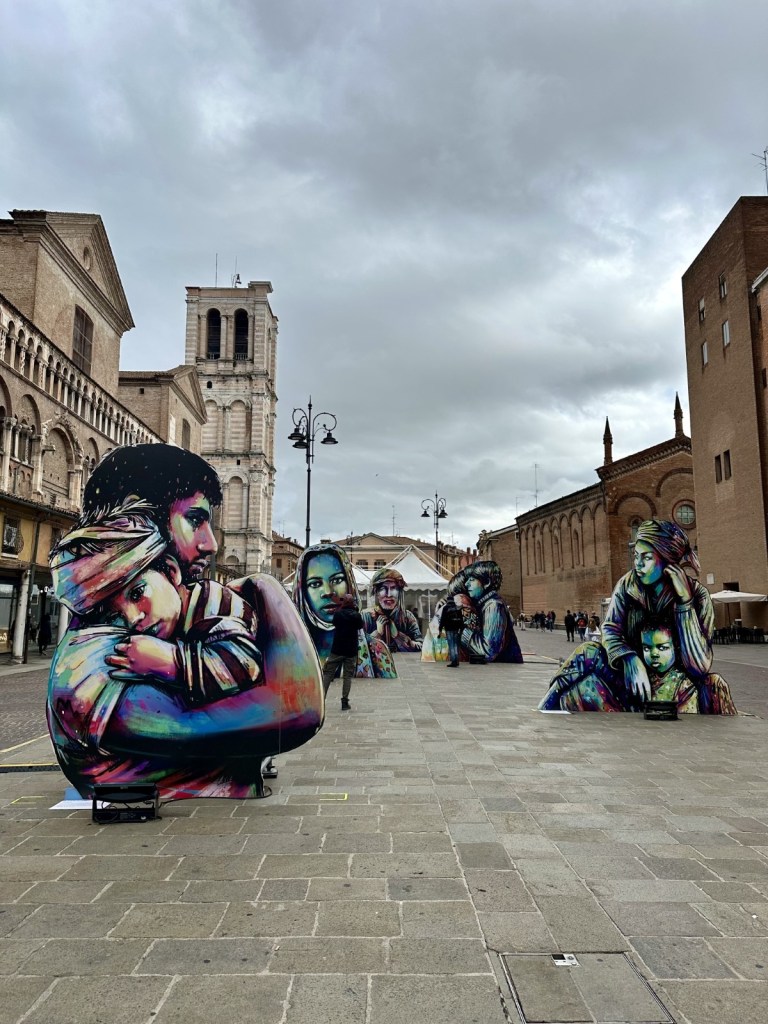
In collaboration with Doctors Without Borders (MSF), the installation draws on five real stories shared by MSF doctors, documenting the devastating toll on civilians in conflict zones such as Palestine, Sudan, and Ukraine.
These stories highlight how innocent civilians, who represent 90% of war casualties, continue to bear the heaviest cost of warfare.
Pasquini’s artwork underscores the urgent need to protect civilians in conflict areas and reminds the public of the violations of international humanitarian law, where civilians are intentionally targeted or caught in the crossfire.
A Year of Escalation
In her March 25 report, “Anatomy of a Genocide”, Albanese documented the systematic destruction of Gaza’s infrastructure, emphasizing the targeted dismantling of Palestinian society.
From the destruction of homes and hospitals to the deprivation of essential services, the violence has not only claimed lives but also obliterated symbols of Palestinian identity.
Albanese noted the destruction of cultural and educational institutions, including libraries, schools, and archives.
“This is an attack on the very existence of Palestinians as a people,” she said.
Israel’s genocidal actions, extend beyond the Gaza Strip, affecting the West Bank and Lebanon, where similar acts of violence and oppression are taking place.
On Sept. 22, Israeli Defense Forces (IDF) soldiers raided the Al Jazeera office in Ramallah in the occupied West Bank.
Journalists were forced to turn off their cameras while their equipment, including cameras and documents, was seized while the office was shut down for 45 days.
The closure of Al Jazeera’s bureau underscores Israel’s increasing efforts to suppress media freedom and control the narrative surrounding its occupation and actions.
Meanwhile, tensions in Lebanon escalated following Israel’s invasion of southern Lebanon on October 1, targeting Hezbollah. This marked the fifth Israeli military incursion into Lebanese territory and followed a series of airstrikes in September.
The conflict has claimed over 3,800 lives in Lebanon, many of them civilians.
On Nov. 26, the US and France-brokered ceasefire between Israel and Hezbollah was approved. It enforces a 60-day halt to fighting, requiring Hezbollah to retreat 40 km north of the Israel-Lebanon border and Israeli troops to withdraw, in line with UN Resolution 1701.
The Role of the International Community
Both Albanese and Nicolai criticized the international community for its failure to act decisively. Albanese highlighted the impunity granted to Israel by major powers, particularly the United States and European Union.
“Resolutions are passed but not enforced, and arms continue to flow to Israel, enabling further atrocities,” she said.
Nicolai echoed these concerns, describing the hypocrisy of states that claim to uphold international law while supplying weapons that fuel the conflict.
“The tools to hold perpetrators accountable exist, but the political will is absent,” she remarked.
On 28 Oct., the Israeli Knesset decided to ban UNRWA, the United Nations Relief and Works Agency for Palestine Refugees in the Near East, from operating in Israel and occupied territories and from coordinating with the Israeli authorities.
“There is no plan B within the United Nations family because there is no other agency capable of providing the same activities,” said Philippe Lazzarini, UNRWA Commissioner-General.
On Nov. 21, the International Criminal Court (ICC) issued arrest warrants for Israeli Prime Minister Benjamin Netanyahu and former Defense Minister Yoav Gallant, accusing them of war crimes and crimes against humanity during the Israel-Hamas conflict from Oct. 2023 to May 2024.
The charges include using starvation as a method of warfare and systematically targeting Gaza’s civilian population through deprivation of food, water, medicine, and electricity.
Netanyahu and Gallant are also accused of blocking humanitarian aid and directing attacks against civilians, actions the ICC called part of a systematic and widespread assault on Gaza’s population.
The court rejected Israel’s challenge to its jurisdiction, citing Palestine’s territorial claims under the Rome Statute. This unprecedented move against a sitting prime minister of a major Western ally intensifies international scrutiny of Israel’s conduct in the occupied territories and Gaza.
Repression of Dissent in Italy
Albanese also turned her attention to the increasingly repressive environment in Italy, particularly addressing the controversial “DDL Sicurezza” (Bill 1660).
Passed by the Chamber of Deputies on Sept. 18, 2024, and now under Senate review, the proposed legislation has drawn widespread criticism for its sweeping restrictions on public protests and dissent.
The bill criminalizes public demonstrations involving violence or threats, with penalties ranging from 18 months to five years in prison and fines of up to €15,000. Roadblocks during protests face similar scrutiny, with individuals risking up to one month in prison and €300 fines. For collective roadblocks, penalties increase to two years in prison.
Stricter measures targeting resistance in detention centers and prisons include sentences of up to 20 years for participants in uprisings. The proposed law also targets migrants, banning the use of SIM cards without valid residency permits and eliminating the option for incarcerated mothers to postpone their sentences.
“This bill heavily undermines the right to protest peacefully,” said Riccardo Noury, spokesperson for Amnesty International Italy.
Albanese condemned the repression of pro-Palestinian demonstrations in Rome on Oct. 7, where police reportedly intercepted participants, preventing them from reaching the protest site. Authorities later dispersed the march using batons, water cannons, and tear gas.
She urged the public to resist any erosion of democratic freedoms. “Be alarmed and take action whenever you witness abuses of power. Always stand up for your rights, freedom, and dignity,” she said.
Her closing remarks emphasized the urgency of collective action.
“Whether in Gaza or Italy, silence in the face of injustice is complicity. Our humanity depends on our willingness to defend it,” Albanese said.
Media Organizations
UNRWA – United Nations Relief and Works Agency for Palestine Refugees in the Near East
Non-profit organizations aiding Palestinians
MECA- Middle East Children’s Alliance
Palestine Children’s Relief Fund
Palestine Red Crescent Society
UN Crisis Relief – Occupied Palestinian Territory Humanitarian Fund
Unicef – United Nations Children Educational Fund
 thematthewrome.com