
Lecture Report
By STAND | Edited by Annalucia Scotto di Clemente
Communications professor and independent researcher, Donatella Della Ratta, was invited by STAND on Oct. 1st to speak to members of the student body and talk about the harsh reality of Gaza from an “Inhumanist Analyst of Contemporary Palestine.” This was an informative and commemorative lecture commenting on how there is no longer a humanitarian perspective after Gaza, while intertwining the teachings of cultural communication philosopher Theodor Adorno and prominent Palestinian-American voice Hala Ayan, and more. Professor Della Ratta presented a critique of humanitarianism, arguing that expressing sympathy or offering aid is no longer sufficient.
The lecture addressed the ethical challenges of representing human suffering, especially during the genocide, which has been a long-standing concern for theorists and writers. As Theodor Adorno famously declared, “to write poetry after Auschwitz is barbaric.” This sentiment echoes through the ages as artists and intellectuals struggle to find a language capable of conveying the horror of such events without trivializing or exploiting them.
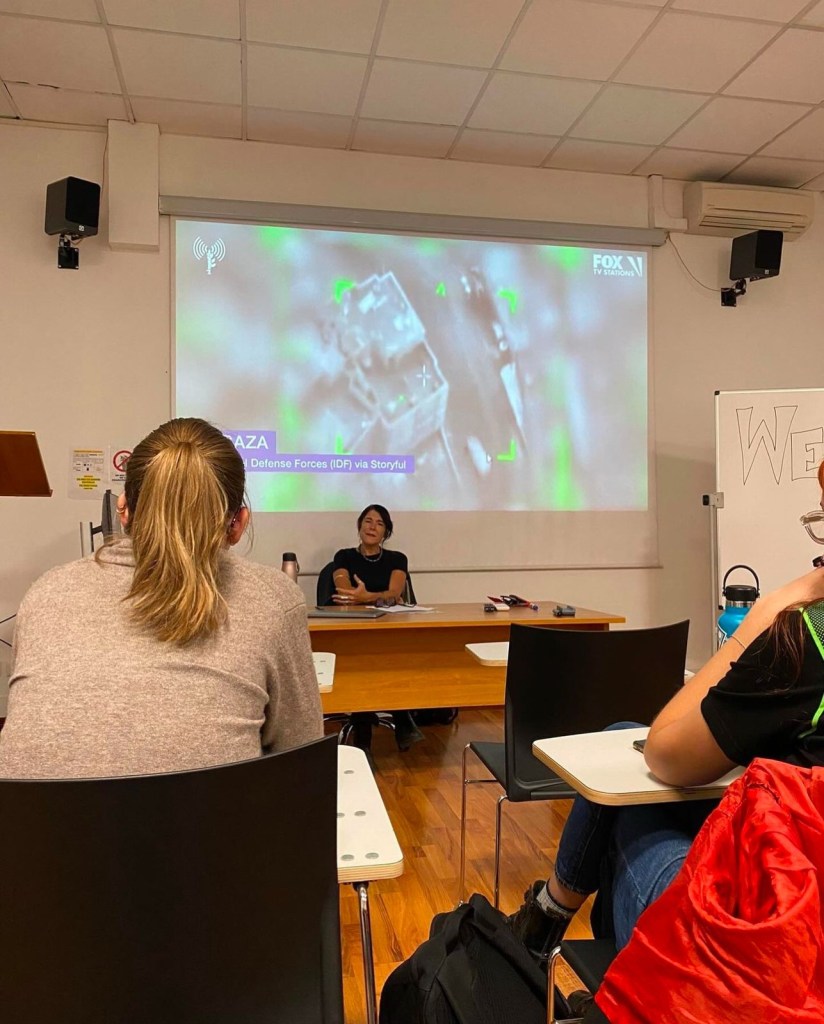
Photo Credit: STAND
“To talk about humanism, humanitarianism, or human rights after Gaza is barbaric,” was the recurring statement by Professor Della Ratta when describing humanitarianism.
The ongoing conflict in Gaza presents a challenge to humanitarism. The violence, the destruction, and the suffering of the Palestinian people raise essential and thought-provoking questions about the boundaries of these concepts. The saturation of violence, the normalization of suffering, and the constant stream of images of destruction have desensitized the global public.
As Hala Ayan observes, there is a “saturation point of horror” beyond which empathy becomes exhausted. The constant barrage of images of Palestinian suffering can lead to “compassion fatigue,” where people become numb to the suffering of others.
Adorno also commented on the artistic depictions of pain, which “contain, however remotely, the power to elicit enjoyment out of it,” further raising the complication of how to move forward if we are profiting from others’ suffering and ultimately diminishing the importance of people suffering due to the war.
Under Netanyahu’s leadership of the state of Israel, governmental policies and actions have critically disregarded international law and humanity. Netanyahu has always maintained little priority for peace and coexistence between Israelis and Palestinians. This was made clear early on in his campaign for office by disregarding the Oslo Accords, which was a pivotal start to peace on the road to Palestinian-Israeli coexistence.
However, in the recent war that started on Oct. 7, the world would watch the true extent of this disregard for coexistence. A disregard that evolves into a disregard for international law, morality, humanity, and Palestinian lives. The world has watched the deliberate targeting of civilians and aid vehicles, the destruction of essential infrastructure, and the imposition of a blockade as a form of slow violence, suffering, and collective punishment for the Palestinian people in Gaza. It is undeniably undermining the fundamental human rights of the Palestinian people.
The “ungrievable life” that was introduced by Judith Butler and discussed by Professor Della Ratta, is particularly relevant to the Palestinian context. Since the state of Israel was created in 1948, Palestinian suffering has often been ignored and/or dismissed by the international community. Even through decades of marginalization and oppression, Palestinian lives have not been valued and not worth mourning from the global or regional perspective.
The situation in Gaza requires an advancement beyond traditional humanist frameworks in order to reinterpret common thoughts regarding political violence and human suffering. As proposed by Jasbir Puar, in-humanist approaches offer a firm critique of how power operates not only to produce but to sustain the hierarchies of life and death.
When recognizing the limits of traditional humanitarian framework and discourse, we are able to develop more effective and nuanced strategies to address the crisis in Gaza. We must demand accountability for war crimes, challenge the desensitization of violence, and work towards sustainable peace for the Palestinian people.
 thematthewrome.com