

A walk between Monteverde and Trastevere reveals the stark contrasts of Rome, exploring how urban art and public space can tell stories of poverty, beauty, and resistance.
Creative Voices
By Annalucia Scotto di Clemente/ Matthew staff | Edited by Meredith Brooks
Walking without a specific destination, guided solely by the impulses and emotions stirred by the surrounding environment; this is the practice of the dérive, a concept developed by the 20th Century Situationists to critically and consciously explore urban spaces. Recently, during my visual activism class, I was given an assignment that, at first glance, seemed simple: wander aimlessly, paying close attention to what surrounded me. Thus, with little expectation, I embarked on my dérive, starting from the Monteverde neighborhood, where I live, and heading towards Trastevere. Monteverde is an area I usually avoid exploring on foot. I live just beyond Trastevere station, a zone where poverty outweighs wealth and numerous homeless people populate the streets, often creating an atmosphere of insecurity; however, I decided it was time to confront these fears and get to know the area that has hosted me for over a year, more closely. So, with a bit of courage, I put on my headphones, started my favorite playlist, and began walking under the sunlit skies of the capital.
Urban Contrasts
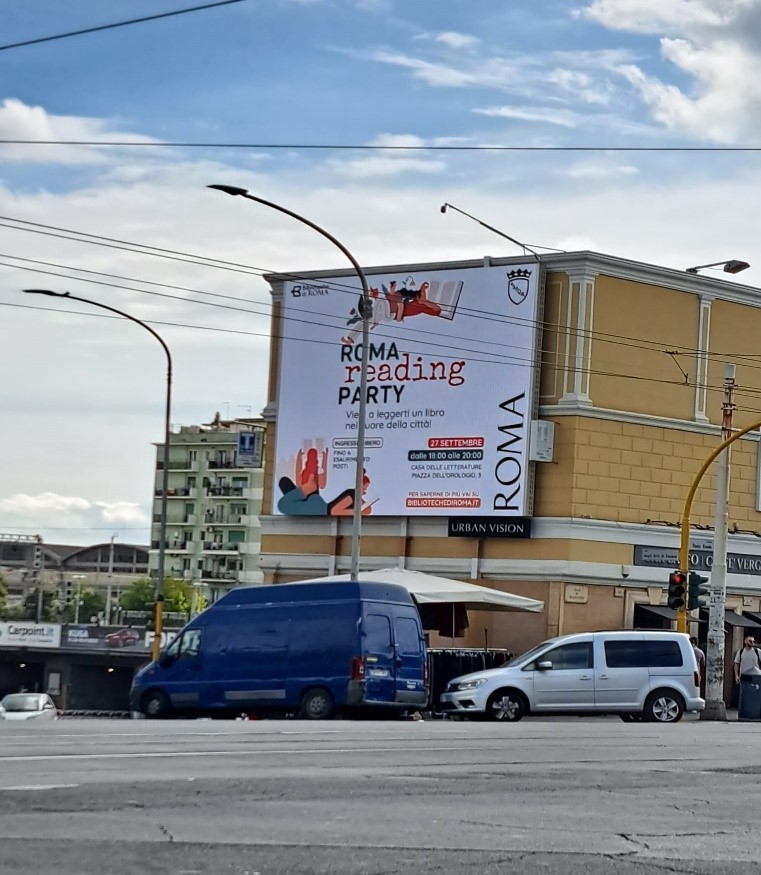
The first strong contrast struck me as soon as I reached Trastevere station. Here, an enormous advertising screen dominates the view, visible from every angle. However, what impacted me the most was the context: at the foot of this symbol of consumerism and luxury, dozens of people were begging for alms or sitting on the sidewalks as if they were in their own living room. This scene generated a profound sense of discomfort and alienation in me, pushing me to reflect on how urban space organization can perpetuate social inequalities. How is it possible that within the same space, almost like in an unintentional parody, advertisements for luxury goods and the harsh reality of poverty coexist?
The Importance of Murals
My journey then took me past a large school, the Orsoline Trastevere, not far from the station. Here, the atmosphere changed drastically. The exterior of the school is adorned with two murals that stretch along the entire facade. The first mural, an explosion of colors and images, depicts a little girl sitting at a desk, sunflowers, children playing, and the word “peace” written in red across the sky. This mural is not just a work of art but a powerful message of hope and collective growth. It brought a smile to my face on an otherwise gloomy day and made me reflect on how urban art can transform a place and the feelings of those who pass through it. In stark contrast to the grayness and noise of the streets I had traveled so far, this mural provided a visual and mental pause – an invitation to stop and breathe.
Next to this, another mural depicts an equally significant scene: arms and hands touching and intertwining, fields of grass with sunflowers, mountains, lakes, colorful flowers, and children playing together under a serene sky. This mural, located at the school entrance, seems to be a visual declaration of what the institution wants to convey to its students: a sense of community, growth, and inner peace. The colorful and harmonious images invite hope and unity, offering a positive contrast to the grayer, busier areas I had crossed during my dérive.

Détournement in Urbanism
As I continued my walk, I observed several examples of détournement: another Situationist practice that involves reappropriating pre-existing images or texts, transforming them into something new and relevant to the current context. Trash bins, covered in graffiti and scribbles, represent an example of how ordinary objects can be transformed into surfaces for creative expression and rebellion. In a sense, these writings subvert the idea of urban order and decorum, becoming a means of communicating disapproval or resistance.
Perhaps this is the deeper meaning of my walk: communication. Never had I so clearly perceived how the objects that make up an urban landscape could express something, almost as if they had their own voice. A wall adorned with a mural or a trash bin covered in graffiti are not just visual elements but real messages, vehicles for thoughts and feelings that rarely find space in public discourse. It’s not about justifying acts of vandalism or the destruction of existing monuments and structures, but rather recognizing that these marks of our presence in the cities reflect a profound need for expression and connection. It’s as if every corner of the street had something to say – a silent story just waiting to be heard.
Reflecting on these signs leads to a questioning of how public space is used and experienced, which voices are amplified, and which remain unheard. After all, a mural is not just a work of art; it’s a cry for identity, belonging, or sometimes protest. Similarly, the scribbles on trash bins speak of unspoken frustrations and desires, of a complex urban reality that often finds no other way to manifest.
During my walk, I realized that the art and messages that populate the city are not merely decorative but powerful tools of communication. They offer a reflection on broader themes such as social injustice, marginalization, and the search for a collective identity. In a sense, the street becomes a place of silent dialogue – a stage where everyone can express themselves, even in unconventional ways.
Perhaps the real challenge is learning to listen to these messages, to grasp the hidden meaning behind a piece of graffiti or an advertisement. By doing so, we might discover a different city, made not just of buildings and streets, but also of stories and emotions – a city that is alive and constantly evolving.
 thematthewrome.com