
The Matthew reports on highlights of conferences attended and conversations with journalists, addressing international journalism and its impact on today’s world.
News
By Annalucia Scotto Di Clemente / Matthew staff and Francesca Rapisarda / Matthew staff | Edited by Federica Bocco
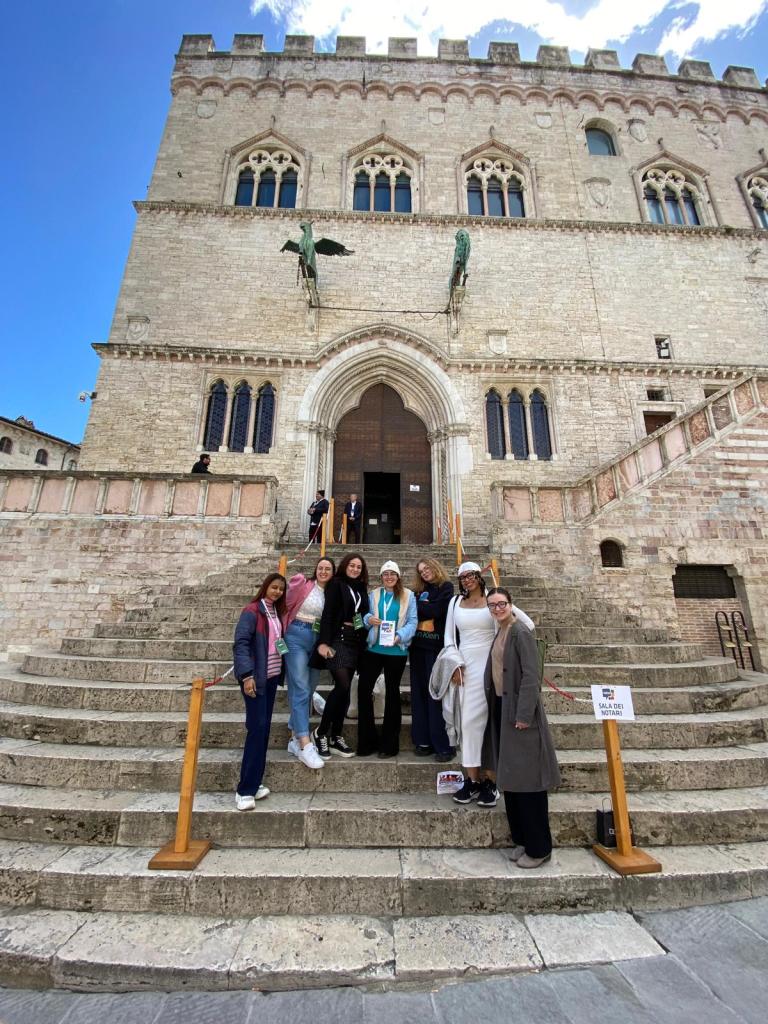
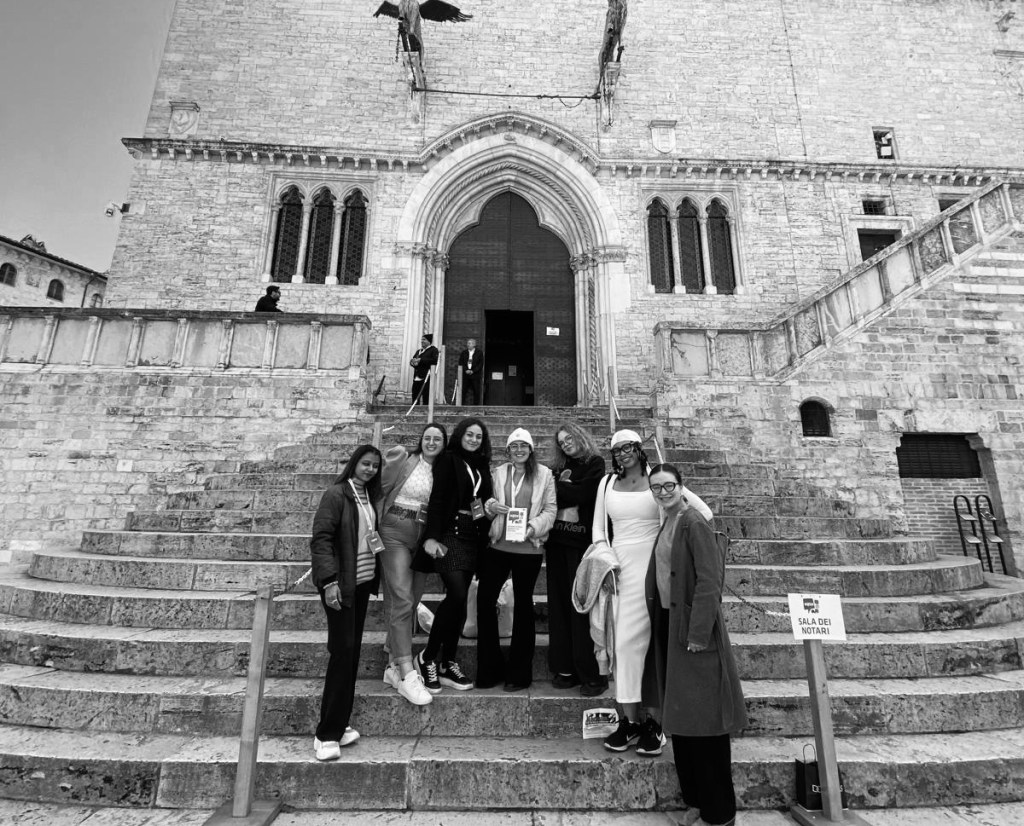
Since 2006, the International Journalism Festival has become a cornerstone event in the world of journalism. This five-day extravaganza draws journalists, scholars, students, media professionals, and enthusiasts alike, converging to explore a myriad of topics discussed across numerous panels and sessions. From dawn till dusk, the city buzzed with activity as attendees, adorned with speakers’ tags, camera-wielding reporters, and curious onlookers clutching leaflets, meandered through the labyrinthine alleys and bustling restaurants, enveloping the town in an electrifying and bustling atmosphere.
But what makes this festival so special? It’s more than just an exhibition of journalistic skills. It’s a catalyst for change and a point of connection among journalists, aspiring ones, and communication agencies. From pioneers of multimedia storytelling to activists for press freedom, everyone finds a place here to express their ideas, share their stories, and build bridges toward a brighter future for journalism.
In the heart of the ancient city of Perugia, surrounded by the flourishing hills of Umbria, a special event takes place every year that brings the international journalism community closer together. The International Journalism Festival, a springboard for bold ideas, revolutionary innovations, and profound discussions about the future of journalism, attracts thousands of bright minds from every corner of the globe every April.
Thanks to the tireless work of Student Services and the active participation of Federica Bocco, Assistant Director of Student Services, six students from John Cabot University (JCU) and members of The Matthew had the extraordinary opportunity to fully immerse themselves in this international experience again. This opportunity not only allowed them to expand their knowledge and skills in journalism, but also facilitated new connections and collaborations with professionals and industry leaders. In an increasingly interconnected and dynamic world, these connections are crucial for the success and professional growth of young journalists, preparing them to face the challenges and seize the opportunities that today’s media landscape offers.
Festival highlights and interviews among the various events attended
For journalists, dealing with social media issues has never been more difficult, yet audience connection has never been simpler. Three seasoned journalists discussed how social media is evolving and what it could mean for journalism in the years to come.
The managing editor and founder of the tech news site, Platformer News, Zoe Schiffer alongside Casey Newton report on Twitter’s X CEO, Elon Musk—after Schiffer quit Vox Media.
Schiffer said that journalists are increasingly aware that their interests do not line with those of large platforms.
“We work for our subscribers at Platformer,” Schiffer said. “For many years, we developed our audiences on platforms and concentrated on scalability. Then the ground gave way beneath our feet.”
Prior to Elon Musk’s takeover, Joanna Geary oversaw Twitter’s news division. She currently works for Bloomberg and stated she anticipated more platform consolidation and adjustments. However, she also exhorted journalists to explore new things and try to establish themselves in these arenas.
“As journalists, we must be present in our communities,” she said.
Deutsche Welle journalist Johanna Rudiger discussed her profession and her sizable following on Instagram and TikTok.
“It’s simple to gain popularity with your opinions, but people value objectivity and that’s how you earn their trust,” Rudiger explained. “The majority of young people use Instagram and TikTok to acquire their news. It follows that being on these platforms is vital for us as journalists. Videos have a greater probability of becoming viral the more newsworthy they are. These videos call for a different kind of narrative and interpretation of the meaning of the content for the audience’s everyday lives.”
In a discussion on investigative reporting, senior editors from the Bureau of Investigative Journalism, ProPublica, and AP talked on how to better tailor their work to the audiences that most need it.
ProPublica’s Tracy Weber outlined their methodology for this extensive probe of the mistreatment of dairy farm laborers in the Midwest of the United States.
“We realized that the people who were affected by our findings needed to hear about them,” said Weber.
Weber talked on the ProPublica Local Network, an initiative that has allowed them to collaborate with over 70 local newsrooms across the United States. They receive assistance from our lawyers and collaborate with one of our editors. The Idaho legislature approved $2 billion USD dollars for schools to replace and repair aging facilities because of one of those probes.
At the International Journalism Festival in Perugia, some speakers raised their voices about Gaza.
“It is extremely sad to see more conferences about AI rather than what is happening in Gaza.”
This is how the first panel titled “Independent Arab Newsroom: the frontlines of the war on Gaza” started about Israel’s war on Gaza, highlighting the necessity to spread the word and to receive help from the international community.
In the final quarter of 2023, the Israel-Hamas war in Gaza started, and Palestinians are still losing their homes, their family members, and slowly, even their hope for a ceasefire. One of the toughest and deadliest professions has been journalism, with an unprecedented death toll that keeps rising every day.
The sessions, mostly held between the central Sala dei Notari and Palazzo dei Priori, focused on the heartbreaking situation in Gaza and the West Bank. Among the speakers were Youmna Elsayed, Al Jazeera correspondent in Gaza, who, in the panel titled “Covering Gaza, Against All the Odds” expressed her disappointment in the international community who, instead of supporting the humanitarian crisis and deaths of Palestinians, is supporting the Israeli government and its right of “self-defense.”
She continues by saying how she had to flee Gaza because she feared for her children’s life, so she had to choose between being a journalist or a mother. She highlighted how privileged she was to even have this “choice” as for many people there were not afforded an option. Thousands must wake up every morning to the sounds of airstrikes, see their houses destroyed and their children killed, without the possibility to evacuate to a safer place.
All the speakers could not stress enough how the genocide of Palestinian women, children and men must end. Palestinians are either dying killed by airstrikes or by heart attacks caused by extreme fear.
Another panel titled “Gaza. We Needed You: Where Were You?” with speakers from the Palestinian Journalist Syndicate, Committee to Protect Journalists, Agency France-Presse, and AlJazeera, talked about the struggle of local journalists in Gaza and the lack of international solidarity towards them.
The spokesperson of the Palestinian Journalist Syndicate Shuruq As’ad, appealed to the audience on the importance of spreading the footage and the words of the journalist in Gaza, because they not only risk their life daily, but they also live in terrible conditions.
Most of the time they are being told by the Israel Defense Force to leave and go to a different area, which is later bombarded. They end up without a place to sleep for themselves and their families and no available food and water. She stressed how no one thinks about these minute details that not only journalists but also residents have to deal with every single day.
Another panel titled “Motaz Azaiza: Gaza Through The Local Leans” mediated by the CEO of the Committee to Protect Journalists, Jodie Ginsberg, showed photos and videos taken by Gazan photojournalist Motaz Azaiza who, instead of following his dream of taking wildlife pictures for National Geographic, found himself in Gaza taking pictures of dead bodies and destroyed houses to show the world what was happening in his country.
Unfortunately, when his mental health started deteriorating and the realization hit that the international community was not going to help but instead was supporting Israel, he decided to leave Gaza and act outside. He began attending international conferences, one of them at the White House, where, up to these days, he has been showing his photos and videos to the world, to raise awareness. awareness.
The panels on Gaza brought awareness of the current war, making us advocate for an immediate ceasefire and the need for a peaceful resolution.
Overall, the conferences held at the International Journalism Festival in Perugia were a meaningful opportunity for journalists to expand their knowledge on current topics that are shaping and transforming journalism.
The festival was an essential reminder of the importance of good, unbiased journalism in our world as well as a hopeful place where ambition for knowledge and facts never stops growing.
 thematthewrome.com