

Through powerful symbolism and controversial sequences, Saltburn begs for reflection on the duality of human nature.
Review
By Francesca Hritcan | Edited by Indea Windust
“I’ll never forget this film. I don’t know if I liked it, hated it, admired it, scared of it, or turned on by it, but I’ll certainly never forget it.”
“Best film of 2023”
“I’m still trying to process it.”
“A masterpiece.”
These are just a handful of the audience’s remarks after watching Saltburn, the new film made by internationally famous director Emerald Fennell, which will be released in the UK on Prime Video on November 17, 2023, and in Italy on December 22 of the same year. The first film’s half is set in Oxford, Britain’s prestigious college, where Oliver (Berry Keoghan) appears to be making his social debut with the division of student tables, which sees him sitting with the “social outcasts,” as opposed to Felix (Jacob Elordi), who is sitting with the “right people,” and surrounded by rich guys like him. The two meet on a fortunate occasion: Felix has punctured a bicycle wheel, and Oliver, who was passing by, saves him by lending him his own. This is a watershed moment for both, because it is at this point that they will get involved in each other’s lives.
The distinction between the two is instantly clear: Oliver is the marginalized and misfit character who is desperately looking for a way to fit in, whereas everyone wants to either be Felix’s friend or be like him. He appears to be the only one, in an environment dominated by falsehood and appearance, who is genuinely interested in others.
During the second film’s part, Oliver is invited to Saltburn, Felix’s family home. In a setting where riches and appearance are fleeting, there is a clear contrast with the fragility, pettiness, and follies of those who live there. In this atmosphere of emptiness, Felix once again appears to be the only one who stands out; on the other hand, Oliver attempts in every way to grab the attention and pity of those individuals while also creating a gap in that world.
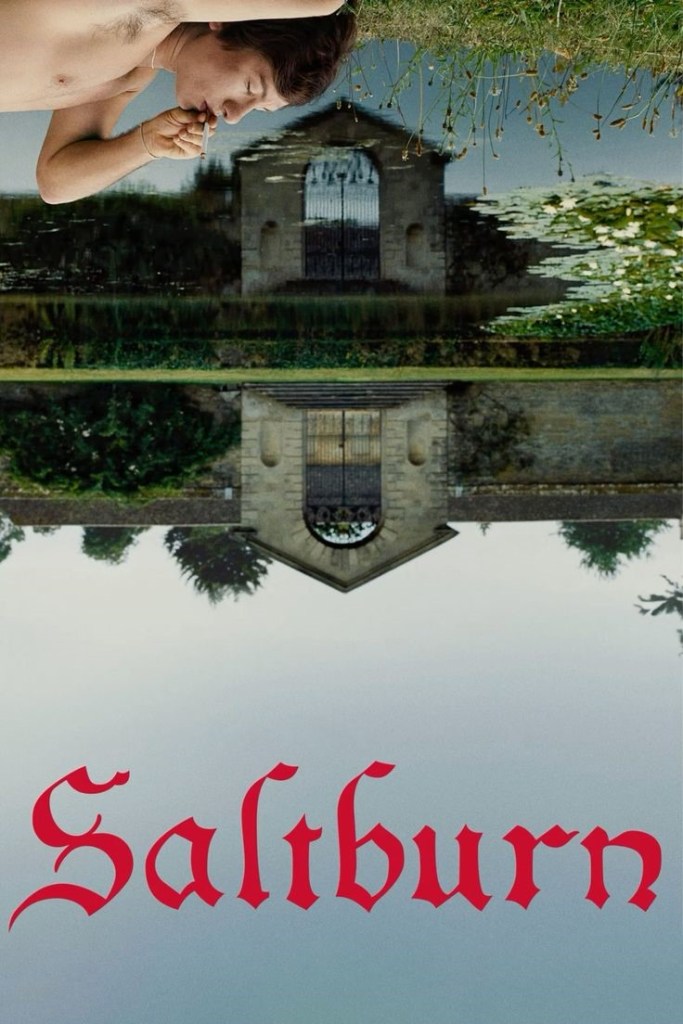
During his stay in Saltburn, the viewer learns about Oliver’s real nature: he manipulates others by becoming what they want him to be, trapping himself in a world where he pretends to be someone he is not. He appears to be a chameleon, changing forms to attempt to charm, provide support or reason depending on the person in front of him––prostrating simply to dominate. There is also a duality in Oliver’s figure; indeed, we always see it told via glass and mirrors; throughout the film, he appears to fight against a picture of himself that even he refuses to accept.
There is important symbology in the film, and there is a religious reading key: during the party in the garden (which later ends up being one of the most fundamental moments) Felix wears wings and represents God, the angel. However, Oliver wears deer horns and represents the devil Lucifer, the fallen angel, and the sacred deer and victim––a symbol of the dualism in his character.
In the end, the devil murders God and dances naked to mock the elitism of those who live there. He prostrated to take his place and emerged victorious despite being the cruel character. Furthermore, some sexual sequences have caused controversy and strife; however, it seems that those scenes were included in the picture to provoke the hypocritical bigots of the people. There is, in fact, a carnal need in every sensual image that wants to be communicated but must remain unspoken. It is all related to the “I want, but I cannot have”, to the ‘odi et amo,’ to a display of dominance. Saltburn is a film that immediately leaves viewers with numerous questions and is a film that scandalizes, leading the human being to question his nature. Upon reflection, the viewer finds that humanity is much more like Oliver than Felix––there is a social decadence today that pushes people to change according to what is expected of them, and they take on different shapes and colors to pass over others and get what they want. Saltburn, in all, is a film that attempts to reveal the monsters concealed in plain sight of civilization.
 thematthewrome.com