

Student Commentary
By Vittoria Caroli / Matthew staff / | Edited by Paige Chinn
On January 29, 2024, John Cabot University had the exceptional opportunity to participate in a lectio magistralis by Pietro Grasso. He shared his personal insights about his time spent with Giovanni Falcone and the years of lead that he personally experienced.
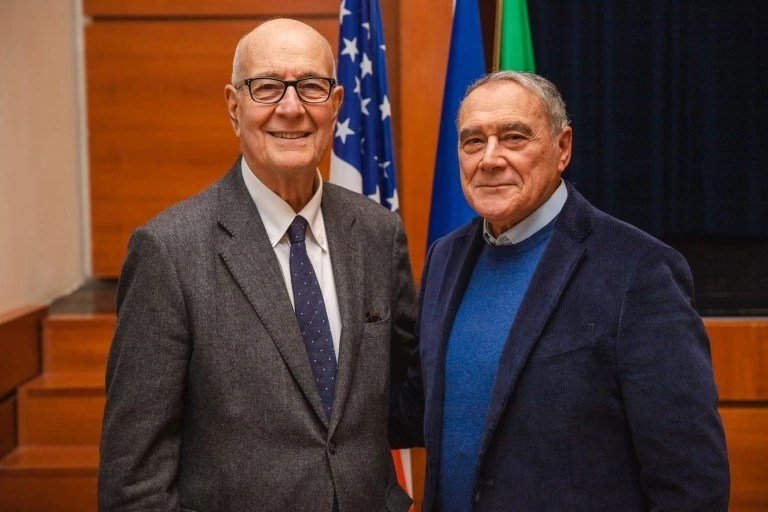
I was one of the students who had the chance to attend the lectio magistralis of Pietro Grasso, the former President of the Senate, an anti-mafia magistrate, and President-founder of the Scintille di Futuro Foundation. He worked side by side with Giovanni Falcone, a name not only familiar to Italians, but also recognized worldwide. Falcone was an Italian judge and prosecuting magistrate.
The former President started off his lecture by quoting what Marcelle Padovani – a French journalist – wrote in the prologue of her book, collaborating with Giovanni Falcone, entitled Cose di Cosa Nostra: “The number one enemy of Mafia.” Falcone had a strong ability to understand the true nature of these criminal organizations, describing it as a phenomenon like no other. Mafia has a beginning, a maturing process, and an end; yet we are still far away from the latter, and it continues to pose a dangerous threat to all democracies, as they act covertly, no longer using a heavy reliance on violence and attacks as seen in the years of lead in the 80s and 90s of the previous century.
During his years of clash against the Mafia, Falcone found the support and pragmatism from the United States extremely helpful. At the forefront of the cases, where the American cooperation brought nothing other than benefits, was the Spatola Trial, the first trial that Falcone ever handled. The name of the trial comes from Rosario Spatola, a mafia boss. Falcone had the ability to discover the underground money laundering process, tracking down its direct routes, stemming from several building companies. This allowed him to conduct other investigations in various banks. This act of bravery is not something every judge would choose to act upon, knowing the deadly dangers involved. The team made up of Falcone and the US, specifically an Alitalia pilot, seized 40 kilograms of heroin that was enroute to the US. Through this operation, they discovered several pizza restaurants involved in the trafficking. This element created the name for the investigation: “Pizza Connection”.
Once more, Dr. Pietro Grasso underlined the importance of the collaboration between the two countries, which has been fundamental for every step taken in each investigation, allowing them to dig into the unknown of these criminal organizations.
investigations, wiretaps, family connections, bonds with bosses, information from justice collaborators, and specific codes or rules followed by the clans – any piece of information would have helped add as many pieces as possible to the puzzle called the Mafia.
These materials were the basis of the so-called Maxi-Trial, one of the greatest trials ever conducted against the Mafia. Pietro Grasso stated that it was “the biggest professional challenge ever faced,” with the postponement of 475 individuals to trial, leading to 92 life sentences.
At this point in the lecture, Mr. Grasso told us about the well-known Capaci attack that happened on May 23, 1992. He explained that he should have been involved too, but he was extremely lucky to have found a flight ticket that saved his life. According to the US, Falcone’s death represented a deep loss for the entire world, yet he did not have the same recognition is his birth nation. “The Americans loved Giovanni Falcone more than a large number of Italians who did not appreciate him as he deserved to be,” said Mr. Grasso before telling us an anecdote that explained why he founded Scintille di Futuro.
A few days before the deadly attack that lead to the tragic death of Giovanni Falcone, he decided to give his lighter to his friend and colleague, Pietro Grasso, because he wanted to stop smoking, and he trusted him. As soon as Pietro Grasso heard about the attack, he ran to the hospital, but he was informed that there was nothing left that they could do to save Falcone. It was at that moment that Pietro Grasso remembered he had Falcone’s lighter. From that moment on, the lighter remained with him; At the end of lecture, he showed the audience the lighter, exclaiming: “This is why I called the Foundation Scintille di Futuro,” which means flames of the future. As a tribute to his colleague, but first, to a life-lasting friend who, throughout that lighter, will always be next to Pietro Grasso.
The last 15 minutes of the lecture were dedicated to a Q&A session, and I took that as an opportunity to ask what it felt like for him when he was standing in front of the mafia bosses during the trial. He answered directly, without hesitation, telling us: “I was anxious before entering the court room, but a wave of adrenaline swept me away and I was ready to face them.” Another interesting question was asked by a professor, inquiring how they, as magistrates, can objectively judge the mafiosi, knowing that they are still human beings. Pietro Grasso replied that “the one of the criminal organizations is a reality where it is not admissible to show any emotions, they must be looked at with detachment.”
Attending this meeting was a wonderful opportunity for the students at John Cabot University to better understand the Mafia phenomenon with a powerful individual who has dealt with such delicate cases, such as the Maxi Trial, and worked together with influential individuals like Giovanni Falcone.
The fight against the Mafia is a never-ending challenge, but that does not mean it is impossible to win.

“You will not find the Mafia if you do not look for it.”
Pietro Grasso
 thematthewrome.com