Are modern heroes in today’s movies and tv series better than the older ones, or is this variety of new heroes meant to show us that everyone has the potential of becoming a hero?
Student Commentary
By Micol Silver | Edited by Ella Schale
Today’s stories have to reexamine their content in the light of many aspects; they must be: politically correct, inclusive, addressing mental health, historically accurate, or justify themselves for not being as such. This is because they have to be true and fair, while also abandoning traditional canons and representing real stories with real heroes. These new heroes have to be flawed; they have to pursue good objectives, but they also have to fail. They need to have a lover, but the plot must not be confined to their relationship, otherwise it is just another Christmas romcom. These heroes have to be independent, brave, but also immature, anxious, and penniless. Yet, despite all these new realistic standards, the modern and conscientious heroes of our times are still subject to debate, leading to questions like: “Should the character conform to the original version?” “Should we consider the villain’s perspective?” or “Should the hero pursue individual objectives instead of a happily ever after?” All questions leading to a bigger one, namely “who is a hero?”
If we look back at Shakespeare’s plays, the main characters end up “either married or dead,” resembling the same instructions given by the editor to Jo March (played by Saorsie Ronan) in Greta Gerwig’s adaptation of Little Women (2019). Jo March, however, does not want her story to be defined by that requirement; she desperately wants to show the world that women are not love and embroidery, but that they have dreams and ambition, just as much as men: this is the modern day heroine, who does not want to fall in love, but reach her goals. Same goes for Greta Gerwig’s adaptation of Barbie (2023), in which the Stereotypical Barbie (played by Margot Robbie) realizes that she does not want to be with Ken (played by Ryan Gosling), but to find her own path (and a gynecologist along the way), thus sending a clear message: today’s women want more, they don’t want love, but to be the authors of their own stories.
Hence, nowadays’ stories are detaching from that “happily-ever-after” narrative, leaving our heroes with bittersweet happy endings where they either fall out of love or choose to leave their lover behind to follow other pursuits, or, more simply, where they have no lovers at all. This new goal-motivated hero is impacting our views on older ones, as the age of reboots, remakes, and spin-offs makes us so nostalgic of the stories of our past while also making us wonder how the latter could speak to the people we are today. This can be seen through the many controversial opinions about the upcoming adaptation of Snow White (2025) in which the Disney princess will be played by Rachel Zegler, who was harshly attacked in her interviews to Variety and Entertainment Weekly for her comments about the original version of the princess, in particular for her observation “we are not in 1937 anymore,” alluding to the detachment of the new character from the original one, who will not be saved by the prince, and whose focus will be that of becoming the leader she was born to be. The message seems to be that becoming “powerful” and “self-asserted” is the new objective to pursue for today’s heroes, which applies to the old heroes as well, who need to be rethought and modernized. The question thus arises spontaneously: “Are modern heroes better than the traditional ones?”
I recently watched the new Italian movie directed by Paola Cortellesi, C’è Ancora Domani, in which the main character, Delia (played by Paola Cortellesi herself) is an ordinary woman living past time, the he post-war Italy, a time which was not exactly feminist-friendly, as women were not allowed to be self-asserted heroes. As a matter of fact, Delia is an housewife who is abused by her husband, appointed as passive by the disgusted look of her daughter, and criticized by her father-in-law because she even dares to respond to him. She dedicates her whole life to the service of others, and yet, in her ordinary submission, she is a heroine. She fights silently, with a gentle smile that covers her bruises while she washes the dishes; she keeps collecting money, but not to use them for an act of resistance or rebellion like Helena Bonham Carter’s character in Enola Holmes (2020) or to escape; her goal is that of giving her daughter, Marcella (Romana Maggiora Vergano), the chance to live a better life than hers. She is not the modern hero of our times: she does not choose to have a career over a love story. She does not prepare a squad of women to win over her violent husband. But the audience will clap to her heroism nonetheless once the movie is over.
On another hand, if even an ordinary woman has the potential to be a hero, so do our villains. Maleficent, Loki, Lucifer, and Cruella, (yes, even the one who hates dogs, as if that could be even possible) have become the heroes of their own stories. How? They all have secret stories, traumas that lead them to be appointed as villains; Maleficent (played by Angelina Jolie) was actually betrayed by Aurora’s father who cut her wings; Loki (played by Tom Hiddleston) has some serious brother issues to cope with, but he just wants to be good. Lucifer (played by Tom Ellis) wants to punish only the bad guys, but he will learn to be merciful. And Cruella (played by Emma Stone) just pretends to have murdered Dalmatians to have a nice coat (thankfully the dogs are okay). All these “bad guys” therefore have the potential to become “good” only if they face the traumas they have been through.
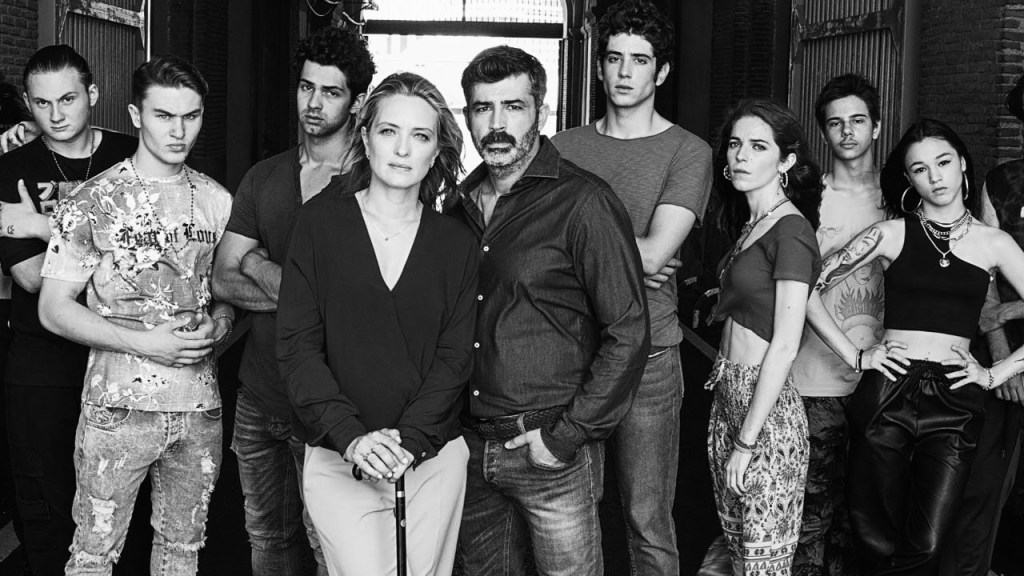
However, if today’s heroes also include yesterday’s villains, then what is the line between who is a hero and who is a villain, which determines the two fighting entities of traditional narratives? This controversy leads to question the basis of characters’ categorization itself, but maybe this confusion is not a big problem. If we get rid of strict boxes to check, excluding the identification of hero and villain, then we are left with the potential of the story itself being the real problem. Or at least, this is the suggestion of the recent phenomenon of Italian tv series, which started from Naples’ sea and reached The New York Times; yes, I am talking about Mare Fuori. A series that destroys the narrative boundaries set by hero and villain, because how can we identify an enemy when each episode shows us a different angle, taking the perspective of a single character, showing us what he or she has been through? All characters follow or defy the rules of a game they did not choose to play, and they are given the chance to rethink themselves in this game, realizing something nobody told them; they can quit the match. But for every hero, quitting the game is the true challenge; and we, the audience, watch them pursuing their task, which changes so quickly, sometimes in the right direction, others in a disastrous one. We root for one character and despise the other, but the next episode might make us completely change our mind; we are fascinated by Rosa Ricci, (played by Maria Esposito) but then we feel sorry for Mimmo (played by Alessandro Orrei). We no longer know if we root for Teresa (played by Ludovica Coscione) or Carmela (Giovanna Sannino). Their stories are all so complex, and at the same time, so simple, because they all share an untold wish, which is that of being happy, peaceful, leave their fights once and for all, because the game has tricked cards, and they keep playing just because they mask their inner desires and insecurities with their performance of “Ce pigliamm’ Napule.” We watch how their stories evolve just to realize, a minute before them, they don’t want to be rulers, they just want to be happy. “I am not bad,” is the line that Totò (Antonio Orefice) keeps repeating in the last episode of the second season. And secretly, all those characters in Naples’ IPM (Istituto Penale per Minorenni) wish to prove the same; they are not bad.
Then, who are the best heroes? The ones who embrace our modern ideas, the traditional housewives, or the ones society appointed as villains until rethinking them just recently? I would say, just like Mare Fuori, our stories show us that we live in a world with neither heroes nor villains. We are all too different to fit into this restrictive label, so it does not matter anymore to find the right category; our variables of heroes, villains, anti-heroes, might serve us to realize that the biggest story that the old and new narratives attempt to communicate is what it means to be a human being. Let us not strive to find out who is the hero and who is the villain. “We can be heroes, just for one day,” sang David Bowie; but we can try to be one tomorrow as well.
 thematthewrome.com