
The 12th annual NASA Space Apps International Challenge has brought together young talents across the world in an attempt to create solutions to challenges faced on Earth and in space. A delegation of JCU’s JERO International Consulting group served as mentors at the event.
News
By Michaela Salzman / Matthew staff || Edited by Sara Segat and Paige Chinn
ROME – On Oct. 7 and 8, JCU hosted the NASA Space Apps International Challenge. This annual event brings together participants from around the globe, uniting a diverse range of talents, including coders, scientists, designers, storytellers, creators, technologists, and innovators. Students from over 34 cities in Italy came together to compete against 50,000 other participants in the world.
Granted the unique opportunity to use NASA’s open data and Space Agency Partners, participants worked through the weekend at JCU’s Guarini Campus to devise solutions to challenges faced both on Earth and in space. Students were given 30 challenges to choose from, attempting to solve one. Challenges ranged from solving Earth’s water crisis to inspiring space education.
In teams, participants worked together to come up with a solution through an app and present it to judges on Sunday at 3 p.m. The criteria for judging were: impact, creativity, validity, relevance, and presentation.

(Courtesy of NASA Space Apps Challenge and MindSharing.tech)
The worldwide prize included a trip to Washington, D.C., where the winning team will be given the opportunity to tour NASA headquarters, present their projects, get feedback on their work, and have special access to NASA laboratories. In addition, local sponsors awarded prizes to those closer to home for their efforts. The United States Mission in Italy awarded €1,000 to the first-placed team, and the Università Campus Bio-Medico offered €500 to the second-placed team. In addition, the Social Hackademy Special Award by EGInA announced they would select a team according to the social impact of the proposed project to attend the Social Hackademy Program 2024.
Among the participants, JCU student and Marketing major Davide Ebraheem embarked on solving one of the 30 challenges. “We are working on creating an app to make users understand water in terms of quality, pollution, and species in it,” said Ebraheem. “The app will give advice to users on what to do or avoid to do to protect endangered species.” Ebraheem joined the challenge after hearing about it in his class, Early Stage Entrepreneurship, with Professor Silvia Pulino, hoping to develop entrepreneurial and communication skills through the pitching of the idea.
On Sunday, Oct. 7, the teams presented their projects, and local awards were announced. The “Social Hackademy” Award went to team “F.A.S,” which created an app allowing people to hear space sounds, specifically catering to a blind audience. The winner of the €500 from Università Campus Bio-Medico was the team “Game Changers.” The first place winner for €1,000 from the US Embassy in Rome was the “Fire Spy Team,” which created an app that allows individuals to call emergency services in the event of a fire in combination with the monitoring of fires from drones and satellites.

(Courtesy of NASA Space Apps Challenge and MindSharing.tech)
The Agencia Spaziale Italiana (ASI) is the most recent sponsor of the event, eager to communicate the importance of international collaboration. Giancarlo La Rocca, a researcher for ASI, shared his excitement during the NASA Space App’s Live Stream to “engage with the young generation to encourage and hear their ideas, creativity, and innovation.”
Even though it is a competition, event leader Benedicta Mary Lee admitted to me that the beauty in the ability to work on it in person is that students can reach out to each other when they need help on something or need expertise in a specific area that someone else may possess. Aldo Pergjergji, the other event leader, had participated in the challenge eight years ago and decided to run the first Italian in- person event in Rome this year. In addition, much of the staff were previous participants, excited to share the knowledge and important skills they learned with other students.
Professor Riccardo Maiolini, Head of the Institute for Entrepreneurship, worked alongside Dean of Academic Affairs, Stefano Arnone, to bring the event to JCU. Arnone said the event “fits with JCU’s mission of promoting an environment to foster intellectuals, knowledge, community, tolerance, and academic freedom, as well as give young students the tools to become passionate leaders.” By hosting the event, they hoped to bring JCU students to the challenge and encourage an environment of extracurricular education.
(Courtesy of NASA Space Apps Challenge and MindSharing.tech)
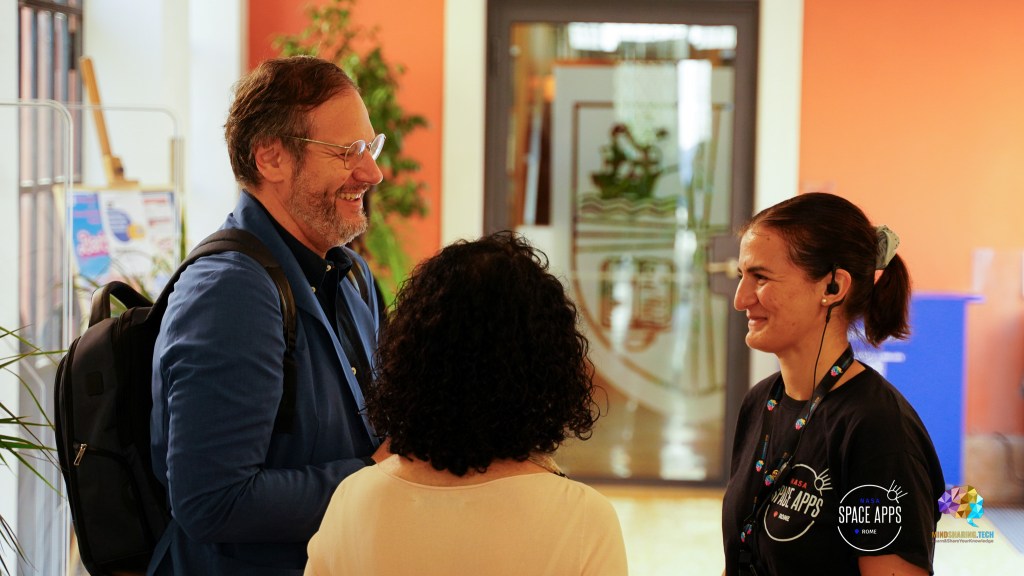
However, JCU’s active participation didn’t stop there. JCU’s JERO International Consulting group played a vital role in students’ presentations and submissions, serving as mentors at the event. They offered assistance to participants in presenting, specifically with the use of Business English, and through a pitch training workshop and an on-demand pitch clinic, helping participants rehearse their pitches. JCU student and Economics & Finance and Business Administration double major Robert Savu, JERO’s President, said their goal is “to give participants’ submissions a more entrepreneurial shape to make their idea more implementable and sharable rather than simply technical.”

(Courtesy of NASA Space Apps Challenge and MindSharing.tech)
According to intern and Research Assistant for the Institute for Entrepreneurship, Aidan Halpin, the NASA Space Apps challenge ties into the goals of the Institute, making their partnership choice an obvious one. Halpin said the Institute and the challenge “share common elements with encouraging technology, team building, problem-solving, and elements involving startups or innovation along with attempting to accomplish something new that no one has before.”
With its global collaboration and connection nature, the Institute of Entrepreneurship aligns with the nature of the hackathon. Halpin adds that both “involve people from all walks of life, from young kids to postgraduates to computer science to pre-med or even English majors.” By tackling real-world challenges and presenting creative solutions, students emphasized the importance of continuous education and innovation, whether on earth or in space.
 thematthewrome.com