
“The recent Nagorno-Karabakh conflict unveils the unstoppable rise of drones in warfare. While promising real-time peacekeeping, their dark side reveals unnerving consequences, from lightning-fast targeting to unbearable psychological pressure. Driven by the deadly efficiency of these aerial marvels, the world watches as they rewrite the rules of warfare.”
Student Commentary
By Nicole Di Maria / Matthew Staff || Edited by Victoria Brizzi
Forty-five days. This is the amount of time that Azerbaijan needed to take over the region of Nagorno-Karabakh. Azerbaijan perpetrated a striking military assault against Armenian forces, pushing Yerevan to its limit and obliging it to both agree to a ceasefire agreement and to withdraw from most of the area under dispute.
Defense analyst Dr. Eado Hecht, in his article Drones in the Nagorno-Karabakh War: Analyzing the Data, presented a table that compares President of Azerbaijan Ilham Aliyev’s summary of Armenian equipment destroyed and captured by the Azeris with what was shown in the Oryx video and photograph collection of it. The table clearly shows how, over a total of 743 items, 563 were drones while only 39 were not. This data is useful to give us an idea of the usefulness of drones in wars. Indeed, they are safe and timesaving, but also deadly.
There is not much literature on drones yet. But they are not so bad after all, aren’t they?
Drones might become extremely important in warfare de-escalation techniques. In crisis zones, military drones provided with precise visual technology can give real-time status updates. This information may be used to track military movements and collect data on the dynamics of conflict, which is critical for making appropriate choices during negotiations. Through drones’ cameras, it might be possible to share live information concerning conflicts’ development for experts to monitor borders and ceasefire zones. With such a rapid transmission of information, international organizations and countries may find it easier to establish humanitarian corridors.
The Washington Post reports that, in the case of Nagorno-Karabakh, drones have shown their increasing importance in verifying the number of losses and attacks, spreading visuals to further propaganda, as well as a more efficient targeting of soldiers, leading to higher human losses. But besides this hopeful vision of drones’ warfare, this changing environment presents high costs as well.
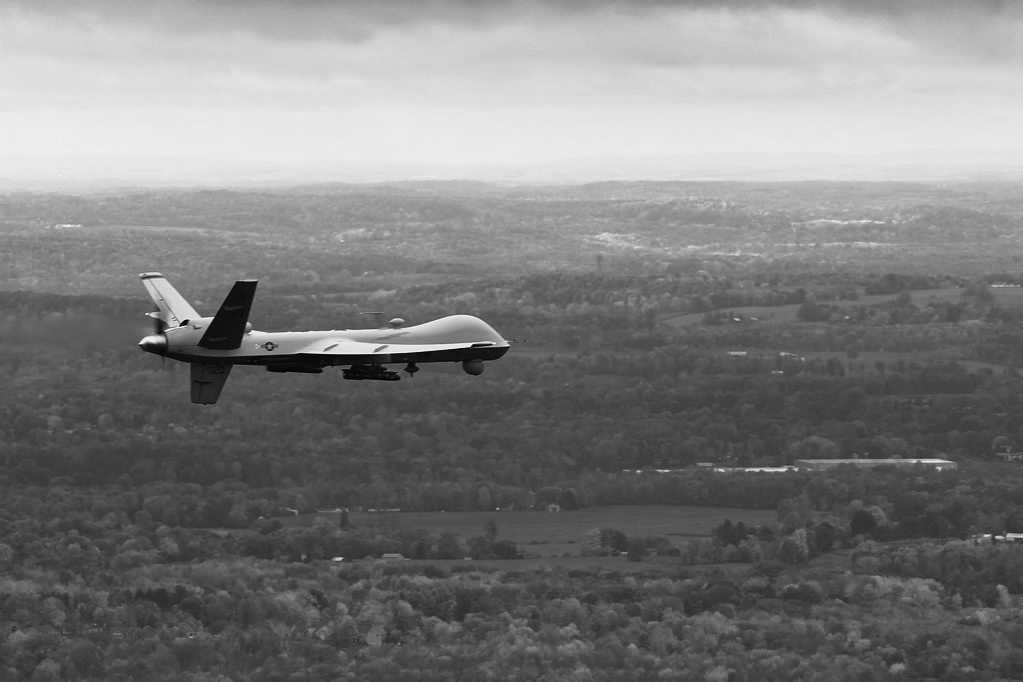
In a lecture offered by John Cabot University and the Guarini Institute, Robert Bruce Adolph — an international speaker, author, commentator, and retired senior US Army Special Forces officer and United Nations security chief — explained what the extremely damaging effects of drone use in Nagorno-Karabakh have been. Adolph participated in a two-month-long UN security consultancy in Azerbaijan this year before the end of the Nagorno-Karabakh conflict.
He explains how drones, equipped with facial and heat recognition, were able to recognize the presence of soldiers from 10 thousand miles in the sky and reach them in only seven seconds. Soldiers, he explained, had only seven seconds to find shelter and save their lives. The abnormal psychological pressure of hearing drones’ noises, as well as seeing videos of other soldiers being killed by such technology was unbearable.
These targeting techniques can also have important impacts on civilians, who might end up on the drones’ radar by accident. Moreover, drones employed in warfare raise the risks of cyber-attacks intended to compromise extremely sensitive data and other drones’ primary functions, as well as furthering tensions and prolonging the conflict. For this reason, and for the delicate technology behind them, drones require high maintenance that drains resources for governments. The moving of resources towards drone operations diverts the funding away from other essentials such as healthcare and safe infrastructure for civilians.
Drones are undoubtedly the future of warfare. This new environment requires there to be a new legal framework, new agreements, and new ethical discussions. It is a scholarly duty to keep researching the topic and to provide data to further future policy-making that is humanly sustainable. Drones’ warfare is posing real threats, and the international community has the responsibility to start adapting.
 thematthewrome.com